Hola, ¿qué tal? means “Hi, how are things?” It works with a friend; Buenos días is a useful opening at a shop counter. In Spain, choose tú for familiar, informal conversation and usted when the relationship or setting calls for more formality. For plans, add a day, time, and place: ¿Quedamos el viernes a las seis en la plaza? means “Shall we meet on Friday at six in the square?”
A greeting you can actually answer
Hola works throughout the day. Use buenos días in the morning, buenas tardes in the afternoon, and buenas noches at night. Exact transitions depend on the situation; you do not need a timetable to say hello. The shortened buenas is a casual greeting you may hear.
After ¿Qué tal?, a manageable reply is Bien, gracias. ¿Y tú? (“Fine, thanks. And you?”). For a formal exchange, use ¿Y usted? Instead of memorising ten greetings, practise one opening and its return question. If you need help, add Estoy aprendiendo español. ¿Puedes hablar más despacio? (“I'm learning Spanish. Can you speak more slowly?”). The formal version starts ¿Puede…?
Tú or usted: look beyond age
The RAE describes tú as informal and associated with familiarity; usted generally signals distance, courtesy, or formality. That is not a rule saying “young person = tú, older person = usted.” A familiar older neighbour and an unfamiliar professional are different relationships. Workplace conventions, local usage, personal preference, and the purpose of the conversation all matter.
When a setting feels formal, usted is a reasonable starting point. Listen to how the other person addresses you, without assuming you must always copy them. You can ask ¿Podemos tutearnos? (“Can we use tú with each other?”). If someone says Puedes tutearme, they are inviting you to use it.
One change of relationship, several changes of words
- Informal
- ¿Cómo te llamas? ¿Cómo estás?
- What's your name? How are you?
- Formal
- ¿Cómo se llama? ¿Cómo está?
- The same questions, addressed with usted.
You can leave out the pronoun: the verb and te / se still show the distinction. Usted takes third-person verb forms, even though you are speaking directly to “you.”
Three everyday encounters
Choose a setting, compare the phrases
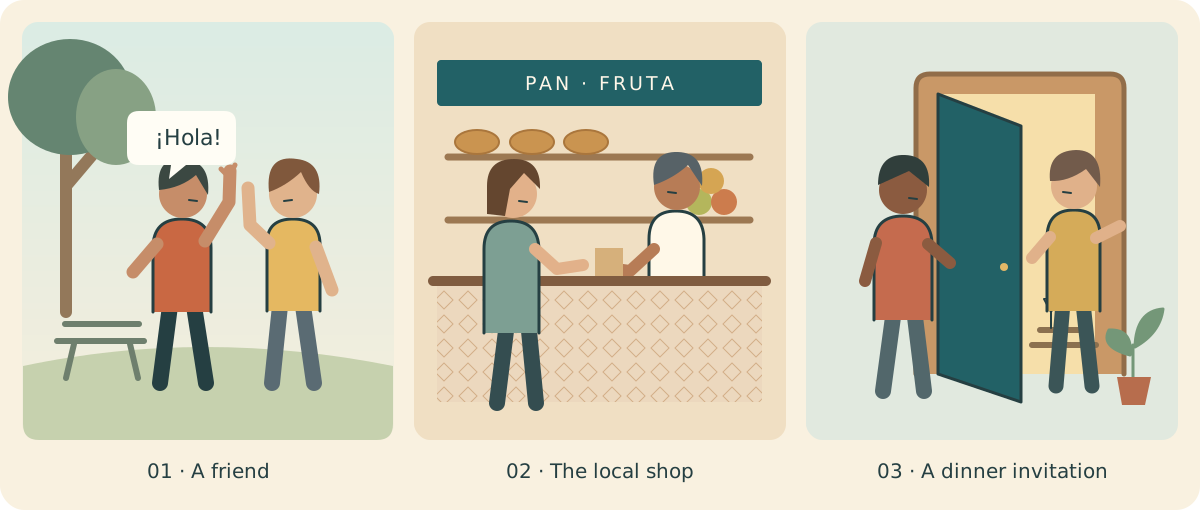
These practice dialogues show possible exchanges, not rules for how everyone speaks. Compare the friendly opening with the more reserved shop greeting.
01 / Familiar
Meeting a friend
Lucía: Hola, ¿qué tal?
Hi, how are things?
Sam: Bien, gracias. ¿Y tú?
Fine, thanks. And you?
Lucía: Bien. ¿Quedamos mañana para tomar un café?
Good. Shall we meet for coffee tomorrow?
Follow up: Sí. ¿A qué hora y dónde? (“Yes. What time and where?”). A friendly yes still needs practical details.
02 / More reserved
At a neighbourhood shop
Customer: Buenos días. ¿Tiene pan integral?
Good morning. Do you have wholemeal bread?
Shopkeeper: Sí, aquí tiene.
Yes, here you are.
Customer: Gracias. Que tenga un buen día.
Thank you. Have a good day.
Compare: Informally, these become ¿Tienes pan integral? and Que tengas un buen día. A shop is not automatically an usted-only space.
03 / Introductions
Arriving at a friend's dinner
Guest: Hola, soy Alex. Gracias por invitarme.
Hi, I'm Alex. Thanks for inviting me.
Host: Pasa. Te presento a Marta.
Come in. Let me introduce you to Marta.
Guest: Encantado. ¿Qué tal?
Nice to meet you. How are things?
Choose the ending: Encantado or encantada means “Pleased to meet you”; its ending agrees with the speaker, not the person being greeted.
Showing all three settings.
Greeting a group: vosotros and ustedes
In much of Spain, informal plural “you” is vosotros, or vosotras for an all-female group. ¿Cómo estáis? means “How are you all?”; ¿Queréis tomar algo? means “Would you like something to drink?” Formal plural address uses ustedes: ¿Cómo están? In the Canary Islands and parts of Andalusia, ustedes also serves informal plural address. For broader contrasts, see Spanish in Spain, Mexico, and Argentina.
Cheek kisses are not a language requirement
You may encounter a two-cheek-kiss greeting in social introductions, but relationship, setting, and individual comfort matter. A smile and a spoken hello also work. If you prefer, say Prefiero saludar sin besos, gracias (“I'd rather greet without kisses, thanks”). Let the other person respond rather than assuming that every introduction calls for kisses.
Quedamos: turn an invitation into a plan
Quedar can mean arranging to meet. ¿Quedamos? asks “Shall we meet up?” In Quedamos a las seis, it can set or confirm “Let's meet at six.” Context matters: quedamos is also a past-tense form, so it does not always describe a future arrangement.
Hemos quedado a las seis means “We've arranged to meet at six.” It describes the arrangement already made; it does not necessarily mean the meeting has happened. Tenemos que quedar un día (“We should meet up sometime”) expresses interest, not a dated appointment. Follow with a specific proposal:
¿Te viene bien el viernes a las seis? — Does Friday at six work for you?
Sí, en la puerta del café. Te mando la dirección. — Yes, at the café entrance. I'll send you the address.
El viernes no puedo. ¿Qué tal el sábado? — I can't on Friday. How about Saturday?
For dinner, ask ¿A qué hora voy? ¿Llevo algo? (“What time should I come? Shall I bring anything?”). Check with your host rather than relying on a supposed national dinner hour. Planning a celebration? Read about New Year's Eve and the twelve grapes.
Leave with the right goodbye
Adiós and hasta luego work in many settings; hasta luego is often a conventional goodbye, not a promise to meet later that day. With friends, ¡Nos vemos! means “See you!” Hasta mañana specifies tomorrow. For a more formal farewell, Ha sido un placer means “It's been a pleasure”; add que tenga un buen día if appropriate. Warmth comes from the exchange, not from choosing the longest phrase.
Follow the conversation into a story
Read Webbu's Spanish short stories with translations and audio, or get a free weekly story at your level. For another everyday exchange, try ordering at a restaurant in Spain.