Spanish customs · A1–B1 language guide
The clock starts chiming, but someone says ¡Todavía no! (“Not yet!”). Why wait? In Spain’s famous New Year’s Eve tradition, the twelve grapes belong to the twelve midnight strokes, not the earlier cuartos. Knowing that difference helps you understand the scene, whether you are watching television with friends or simply learning the words.
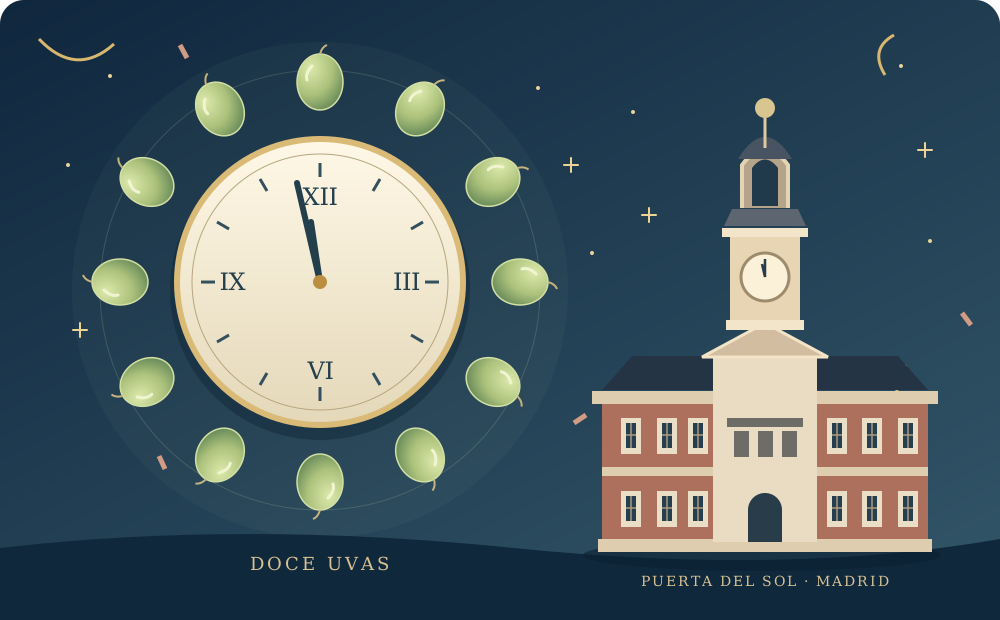
The short answer: Nochevieja is New Year’s Eve, 31 December. Many people in Spain welcome the year with doce uvas, twelve grapes, traditionally one for each midnight chime. They symbolise good luck for the twelve months ahead. Afterwards, ¡Feliz año nuevo! means “Happy New Year!” Joining the grape custom is optional; understanding it does not require eating anything.
Nochevieja is not the same as Año Nuevo
La noche means “the night” and vieja means “old”, but learn Nochevieja as one word: New Year’s Eve. Año Nuevo names New Year’s Day, 1 January. In a greeting, año nuevo also refers to the new year ahead. The small mark in año matters: ñ is a different letter from n.
- ¿Qué haces en Nochevieja?
- What are you doing on New Year’s Eve?
- Cenamos en casa.
- We’re having dinner at home.
- El día de Año Nuevo comemos con mi familia.
- On New Year’s Day we’re having lunch with my family.
You may also hear fin de año, “end of the year”, in descriptions of dinners and celebrations. Esta noche means “tonight”; mañana means “tomorrow”. Those two words help keep a conversation about dinner on the 31st separate from lunch on the 1st.
The clock: cuartos first, campanadas second
Madrid’s Puerta del Sol is the best-known setting for the televised chimes. The clock stands on the Real Casa de Correos. According to Madrid’s official tourism guide, a ball descends with a carillon sound, followed by the four cuartos, then the twelve campanadas. The first sounds are not the twelve-stroke sequence. A useful sentence is Son los cuartos. (“Those are the quarter chimes.”)
Read the sequence, not the seconds
Three stages around midnight
This is a self-paced explanation, not a recording, live clock, or eating challenge. Select a stage to highlight it. There is no timer.
- Before midnight: watch and listen. The descending ball and carillon introduce the sequence at Sol. They are not the twelve midnight strokes.
- Los cuartos: todavía no. The four quarter chimes come next. “Not yet” is the practical distinction to remember; do not count these as the twelve.
- Las doce campanadas. These are the twelve midnight strokes associated with the grapes. After the sequence, people exchange New Year wishes.
Cuartos come before the twelve midnight strokes.
The custom is also called las uvas de la suerte, “the lucky grapes”. Stories about its beginnings differ; even Madrid’s tourism page introduces several theories. You do not need to memorise a single supposed invention date to understand what people do today.
Ask about plans without needing complicated grammar
Spanish often uses the present tense for an arranged future plan: Ceno con amigos. means “I’m having dinner with friends.” For a simple question, use ¿Qué haces en Nochevieja? You can answer with a place, company, or both. Here is a practice exchange, not a script every household follows.
Lucía: ¿Qué haces en Nochevieja?
What are you doing on New Year’s Eve?
Dani: Me quedo en casa con unos amigos.
I’m staying at home with some friends.
Lucía: ¿Vais a ver las campanadas?
Are you going to watch the midnight chimes?
Dani: Sí, en la tele.
Yes, on TV.
Vais a ver addresses more than one person informally in Spain; ¿Vas a ver…? addresses one. La tele is everyday Spanish for television. If somebody offers grapes and you prefer not to have them, No, gracias. Prefiero mirar. means “No, thank you. I’d rather watch.”
If you receive an invitation, ask ¿A qué hora cenamos? (“What time are we having dinner?”) rather than guessing a schedule. ¿Llevo algo? means “Shall I bring anything?” These questions work for a quiet meal as well as a larger gathering. To make your own answer, keep the beginning Ceno con… and add mi familia (“my family”) or unos amigos (“some friends”). For a different plan, Voy a salir después de cenar. means “I’m going out after dinner.” Notice that después de is followed here by the infinitive cenar, “to have dinner”. You can reuse that small pattern without changing the rest of the sentence.
What to say when the year changes
Match the greeting to the moment
Try saying the Spanish before reading the translation. The optional practice buttons highlight a suitable line; every answer stays visible.
¡Que lo pases bien!
Have a good time! Say this to one person heading off to celebrate.
¡Feliz año nuevo!
Happy New Year! The straightforward greeting when the year changes, also useful in messages.
¡Igualmente!
Same to you! A short, friendly reply to a good wish.
Choose a situation to focus your practice.
You may hear the shorter ¡Feliz año! too. For an extra wish, Te deseo un año lleno de salud. means “I wish you a year full of health.” Learn the whole expression first; you do not need to master the grammar of wishes before using a friendly greeting.
A celebration is not a fixed itinerary
Some people celebrate at home; others go out. Neither a crowded square nor alcohol is required. If you want to visit Sol, check current official access rules and transport information before travelling. This language guide does not promise entry or give an arrival time.
For everyday conversations around the holiday, continue with Spanish greetings and social etiquette. For another useful scene, read ordering coffee and breakfast in Spain.
Read the next conversation in Spanish
Explore Webbu’s Spanish short stories with translations and audio, or get a free weekly Spanish story at your chosen level. Start by spotting a greeting you now recognise.