¿Tú tienes coche? and ¿Vos tenés auto? both ask “Do you have a car?” The first fits many conversations in Spain; the second fits Argentina. What changes most is how you say “you,” a handful of everyday words, and the sounds you hear. Most of the grammar and vocabulary stays shared.
You do not need three separate beginner courses. Pick a variety that fits your plans, then learn to recognise the alternatives. No variety is purer or better. And “Latin American Spanish” is not one accent: Mexico, Argentina and their neighbours contain plenty of variation themselves.
One language · three starting points
Compare what you would actually say
Choose a focus to highlight its column and practice card. Everything stays available for side-by-side reading; the table also works without JavaScript.
No focus selected. Compare all three columns below.
| Meaning | Spain | Mexico | Argentina |
|---|---|---|---|
| You have (one familiar person) | Tú tienes | Tú tienes | Vos tenés |
| You have (a familiar group) | Vosotros tenéis in much of Spain | Ustedes tienen | Ustedes tienen |
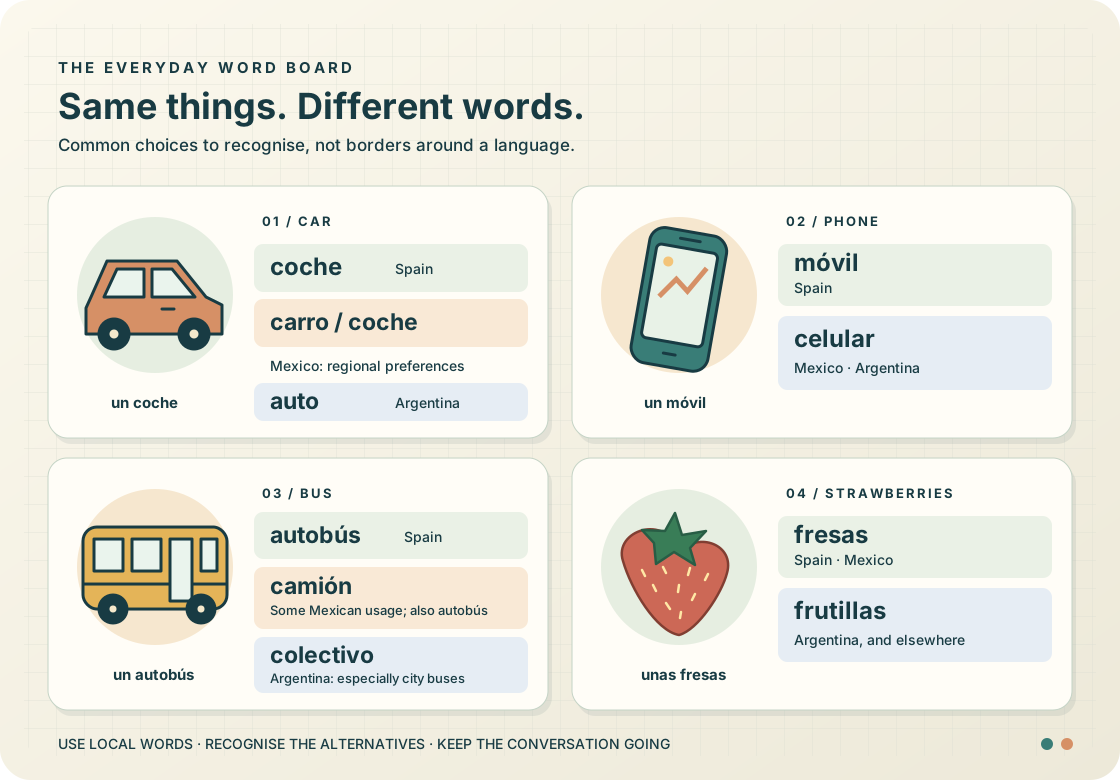
| Car | Coche | Coche / carro (regional preferences) | Auto |
| Mobile phone | Móvil | Celular | Celular |
| Bus | Autobús | Autobús; camión in some places | Colectivo, especially city buses |
| Strawberry | Fresa | Fresa | Frutilla |
Spain focus
Meet one friend, then two
¿Tú tienes tiempo?
¿Vosotros tenéis tiempo?
“Do you have time?” First to one friend, then to a group in much of Spain.
Practise: recognise the change from tienes to tenéis.
Mexico focus
Keep the singular; change the plural
¿Tú tienes tiempo?
¿Ustedes tienen tiempo?
“Do you have time?” Ustedes works for a group of friends as well as a formal group.
Practise: learn tienen as the everyday plural “you have.”
Argentina focus
Notice the singular ending
¿Vos tenés tiempo?
¿Ustedes tienen tiempo?
“Do you have time?” Vos addresses one person; it is not a shorter vosotros.
Practise: pair vos with tenés, not tenéis.
“You”: the grammar worth learning first
In much of Spain, use tú for one familiar person and vosotros for a familiar group (vosotras for an all-female group). For a more formal relationship, usted takes tiene; plural ustedes takes tienen. The Canary Islands and parts of western Andalusia use ustedes for informal groups too. Spain is not one uniform pronoun system.
In Mexico and Argentina, ustedes is the ordinary plural for both familiar and formal situations. It does not automatically create distance. Singular usted often signals respect or formality, but relationships and local habits matter more than a fixed age rule.
Mexico generally uses tú; vos also occurs in parts of the southeast. Argentina widely uses vos, called voseo. Compare these present-tense pairs:
- Tú hablas / vos hablás — you speak.
- Tú comes / vos comés — you eat.
- Tú vives / vos vivís — you live.
- Tú eres / vos sos — you are.
The written accents mark stress on the last syllable in hablás, comés, vivís. Keep te and tu: Vos te llamás Ana. ¿Este es tu celular? means “Your name is Ana. Is this your phone?” You do not need to rebuild every pronoun around vos.
Pronunciation: what to listen for, not imitate from this audio
All regional sound comparisons here are explained in text only. This page's audio uses a Spain voice. It cannot demonstrate Mexican, Argentinian or other regional accents.
Seseo and distinción
With seseo, s, z and c before e/i have the same “s” sound. So casa (house) and caza (hunting) sound alike. This is general across Spanish-speaking America, including Mexico and Argentina, and also occurs in the Canary Islands and parts of Andalusia.
With distinción, common in much of central and northern Spain, those last two spellings have a sound like “th” in English “think,” different from s. This is not a lisp, and not everyone in Spain uses it. Andalusia also has other local patterns. Neither seseo nor distinción changes the spelling of a word.
Yeísmo and the Río de la Plata
Yeísmo means that ll and consonant y share a sound. It is widespread in both Spain and the Americas, but that shared sound varies. In Rioplatense speech, associated especially with Buenos Aires, surrounding areas and much of Uruguay, it may resemble English “sh” or the middle sound in “vision.” Thus calle (street) can sound different from the version in your Spain lesson.
These are not universal Argentinian sounds. Argentina includes other regional varieties, and Rioplatense Spanish crosses a national border. Some speakers elsewhere still distinguish ll and y. Learn to recognise the word before trying to copy every local sound.
Four objects, not four translation rules
The board gives practical defaults. Coche is useful in Spain; Mexico uses both coche and carro, with regional preferences. Auto is common in Argentina. These choices overlap: hearing a different word does not identify someone's nationality.
For a phone, learn móvil for Spain and celular for Mexico, Argentina and many other American settings. Transport needs more local attention. Camión means a bus in some Mexican usage, not everywhere in Mexico; it can also mean a truck. Autobús remains useful. Argentina's colectivo commonly means a city bus, while in countries such as Chile the same word can mean a shared-route taxi.
Fresa and frutilla both name a strawberry. The latter is also used in Chile, Uruguay, Bolivia and Ecuador, not just Argentina. Learn the noun with its article and a situation: un kilo de frutillas, “a kilo of strawberries,” is easier to remember than a country label.
One small conversation, three written versions
These parallel scenes show grammar and word choice, not accent. The English meaning stays the same: “Do you have a car?” “No. Are you taking the bus?” “Yes. I have the route on my phone.”
Spain
A: ¿Tú tienes coche?
B: No. ¿Vas en autobús?
A: Sí. Tengo la ruta en el móvil.
Mexico
A: ¿Tú tienes carro?
B: No. ¿Vas en autobús?
A: Sí. Tengo la ruta en el celular.
Argentina
A: ¿Vos tenés auto?
B: No. ¿Vas en colectivo?
A: Sí. Tengo la ruta en el celular.
Audio: Spain-Spanish reading of the written example; not a regional accent demonstration. This applies to every audio button on this page.
Beyond the three columns
In Caribbean varieties, a syllable-final s may weaken to an English “h”-like sound or disappear. In los amigos, “the friends,” that can make the plural less obvious to a beginner. This varies by speaker and setting, and also happens outside the Caribbean.
Andean Spanish is not one system either. Peru mostly uses tú, while forms of voseo occur in parts of Bolivia and Ecuador. In informal Chilean speech, you may encounter tú tenís, “you have”: the familiar pronoun and verb ending need not match the Argentinian pattern. Across much of Central America, including Nicaragua and Guatemala, vos is an important familiar form; its relationship with tú and usted varies locally.
What should an A1–B1 learner prioritise?
- Speak consistently enough to practise. Going to Spain? Learn vosotros. Building relationships in Argentina? Learn common present-tense vos forms early. For Mexico, start with tú and ustedes.
- Understand more than you produce. Recognise tenés even if you say tienes. You can understand a second variety without switching your whole speaking style.
- Ask about local words. ¿Cómo se dice aquí? means “How do you say it here?” Transport words are a good first question.
Two phrases to keep a conversation going
¿Cómo se dice aquí? — How do you say it here?
¿Puedes repetirlo más despacio? — Can you repeat it more slowly?
For a Spain-focused next step, practise greetings and social etiquette or ordering at a restaurant in Spain.
Meet the words in a story
Read a short scene in the Spanish short-story library, follow the conversation, and revisit the words you need. Or get a free weekly Spanish story at your chosen level.