Start with Hola, una mesa para dos, por favor. Ask for la carta, then order with Para mí… and the dish name. If you want the fixed-price lunch, ask about the menú del día first. Those three steps take you from the door to your order without a long speech.
Arriving: a table, a reservation, a little time
Greet the person seating customers before taking a table, including on a terrace. ¿Tenéis una mesa para dos? means “Do you have a table for two?” You may hear ¿Tenéis reserva? (Do you have a reservation?). Answer Sí, a nombre de… (Yes, under the name…) or simply No, no tenemos reserva.
Una mesa para dos, por favor. A table for two, please.
Spain's tourism office gives approximate restaurant service windows of 1–4 p.m. for lunch and 8–11:30 p.m. for dinner. Local habits, season and kitchen hours vary; an open bar may not be serving meals. Ask ¿Está abierta la cocina? (Is the kitchen open?). Book ahead if a particular restaurant matters to your plans.
Carta or menú del día?
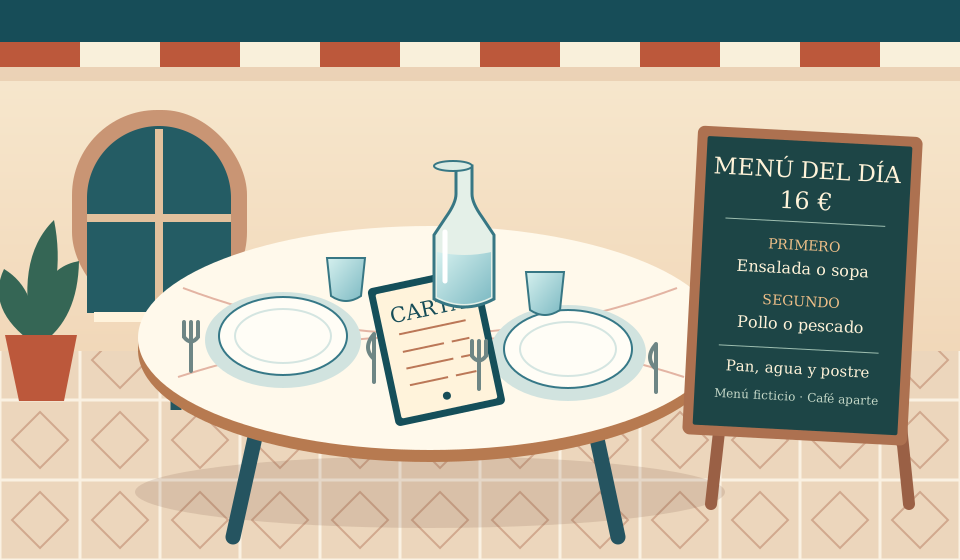
English “menu” can lead to a small misunderstanding. La carta is the list of dishes and their individual prices. Un menú usually means a set meal. The menú del día is a fixed-price offer commonly served at lunchtime, often on weekdays. Not every restaurant offers one.
¿Nos traes la carta, por favor? Could you bring us the menu, please?
- Primer plato / primeros
- On a set menu: the first-course choices. Choose one, rather than ordering everything listed.
- Segundo plato / segundos
- On that set menu: the second-course choices, often the more substantial dish. Again, choose one.
- Postre o café
- Dessert or coffee. If the offer says “or”, don't assume you get both.
- Bebida incluida / suplemento
- A drink is included / an extra charge applies. Check which drinks and dishes qualify.
This first-course/second-course structure belongs to the set-menu offer, not every restaurant meal. From the carta, you can order an individual dish; sharing arrangements depend on the restaurant. Ask ¿Qué incluye el menú? (What does the set menu include?) before assuming bread, drinks or dessert are covered.
Ask what arrives on the plate
¿Qué lleva este plato? asks “What's in this dish?” For the side dish, try ¿Con qué viene? (What does it come with?). Useful menu clues include a la plancha (griddled), al horno (oven-baked) and frito (fried). They describe cooking methods, not a complete ingredient list.
¿Qué nos recomiendas? What do you recommend for us?
Para mí, el pollo, por favor. is a natural order. Me pones… (Could I have…) is also common in informal service in Spain. A greeting, a normal tone and por favor do more work than an elaborate sentence. The informal singular forms traes and recomiendas address one server; tenéis addresses the restaurant team.
Listen for ¿Ya sabéis? (Have you decided?), ¿Y de segundo? (And for your second course?) or No queda (There's none left). If you need time, say Un momento más, por favor. For a fast answer, try Más despacio, por favor. (More slowly, please.)
Your turn at the table
Choose your restaurant conversation
These fictional examples practise different decisions. Read the server's question, say your order aloud, then check the suggested answer.
01 · Order the set lunch
Practice board: €16. First: salad or soup. Second: chicken or fish. Bread, one water and dessert included; coffee extra.
Server: ¿Qué vais a tomar de primero y de segundo?
They ask what you'll have for each course. Order the salad first and chicken second.
Check a possible order
De primero, la ensalada, y de segundo, el pollo, por favor.
Server: Muy bien. ¿Y para beber?
“Very good. And to drink?” Say Agua, por favor. Here, the fictional offer includes one water, not unlimited drinks.
02 · Order one dish from the carta
Practice carta: vegetable plate €12; chicken with potatoes €15. Drinks priced separately.
Server: ¿Ya sabéis lo que queréis?
“Do you know what you'd like?” Choose the vegetable plate for yourself.
Check a possible order
Para mí, las verduras a la plancha, por favor.
Server: ¿Algo más?
You: Nada más, gracias.
“Anything else?” “Nothing else, thank you.” No set-menu second course is required.
03 · Your first choice has run out
Server: Lo siento, no queda sopa. Tenemos ensalada.
“Sorry, there's no soup left. We have salad.” Accept the alternative, then check whether it contains cheese.
Check a possible reply
You: Entonces, la ensalada. ¿Lleva queso?
Server: Sí, pero podemos prepararla sin queso.
“Then the salad. Does it contain cheese?” “Yes, but we can prepare it without cheese.” This is a practice reply, not an assurance about allergy safety.
Water and dietary needs: be specific
Agua del grifo, por favor. Tap water, please.
Spanish law requires hospitality businesses to offer free non-bottled water. Specify tap water rather than just agua if that's what you want. Bottled water is normally charged; con gas means sparkling and sin gas means still.
For a vegetarian option, ask ¿Tenéis algún plato vegetariano? If needed, clarify Sin carne ni pescado. (Without meat or fish.) For vegan food, ask about eggs, dairy and other animal ingredients too. A vegetable name alone doesn't establish suitability.
Finishing and choosing your next meal
La cuenta, por favor. asks for the bill. For payment questions, use our separate guide to asking for the bill in Spain. Planning a different kind of meal? Read about ordering tapas or ordering paella in Valencia.
Practise reading Spanish next
Browse Spanish stories with translations and audio, or sign up for Spanish reading practice. Start by recognising the small words from your order: para mí, primero and sin.