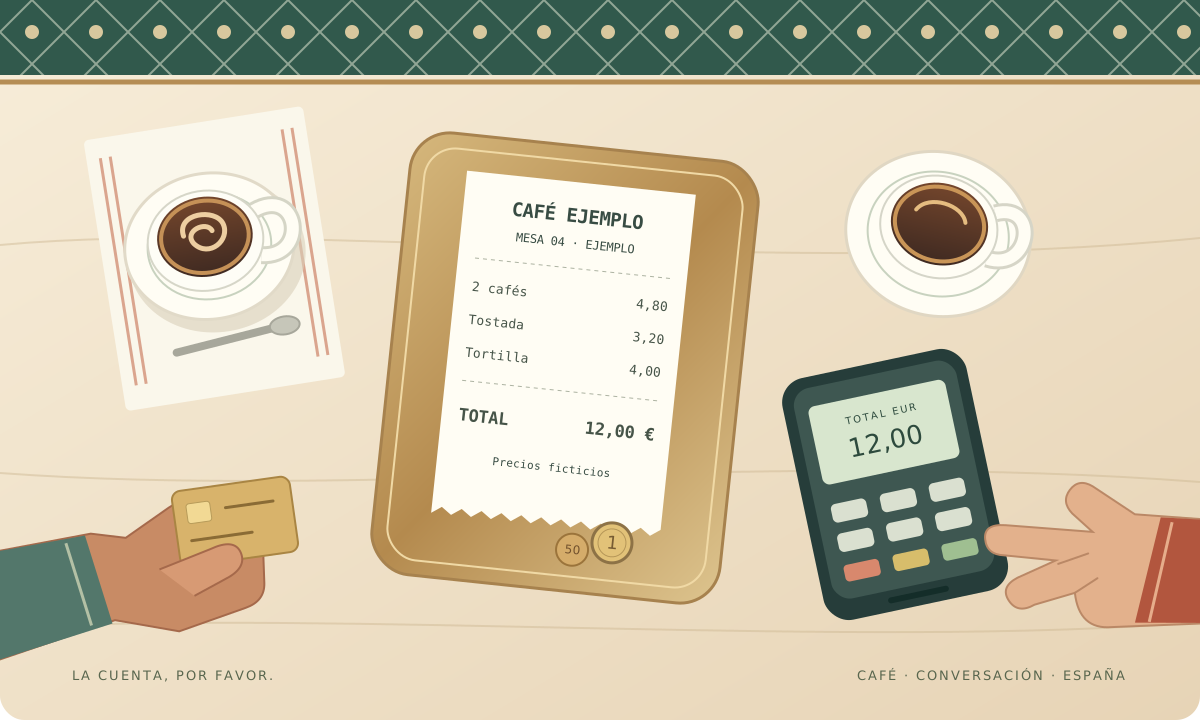
Two coffees finished, one bill to settle. Say La cuenta, por favor. to ask for the bill in Spain. Ask whether you can pay by card, agree with your companion how to divide the cost, and check the total. A tip is optional: you do not need to add a compulsory US-style percentage.
The useful distinction is between por separado (separately) and a medias (half each, for two people). Neither tells you whether the café can process two card payments. Agree on the amounts with your friend, then ask the server what is possible.
Get the bill, then ask about payment
You do not need a long sentence. Catch the server’s attention politely with Perdona (“Excuse me”), then ask for la cuenta. Add por favor rather than trying to translate “Can we get the check?” word for word.
You: La cuenta, por favor.
The bill, please.
Server: Sí, ahora mismo.
Yes, right away.
You: ¿Se puede pagar con tarjeta?
Can we pay by card?
Server: Sí. Os traigo el datáfono.
Yes. I’ll bring you the card terminal.
Os here means “you” when addressing several people informally in Spain. El datáfono is the card terminal. Cards are widely used, according to Spain’s official tourism website, but check your particular card and any minimum payment before ordering if you depend on it.
For cash, ask ¿Podemos pagar en efectivo? (“Can we pay in cash?”). A possible answer is Sí, en la barra, por favor. (“Yes, at the counter, please.”). Follow the venue’s instructions rather than assuming payment always happens at the table.
The €12 table
Who pays what? Try three conversations
In this invented café order, you have a coffee and toast; your friend has a coffee and tortilla. Read all three arrangements below, or select one to focus on its amounts and conversation. These are practice prices, not a guide to what cafés charge.
CAFÉ EJEMPLO
Fictional bill · Table 04
| Item | Amount |
|---|---|
| 2 cafés × 2,40 € | 4,80 € |
| 1 tostada | 3,20 € |
| 1 pincho de tortilla | 4,00 € |
| Total | 12,00 € |
Final illustrative total. No tip added.
The arithmetic
- Own items: you €5.60; friend €6.40.
- Half each: €6.00 + €6.00.
- Your treat: you €12.00; friend €0.
The total stays €12.00. Choosing a split changes who pays, not the café’s prices.
Paying for your own order: por separado
Por separado means separately, not necessarily equally. Say which items or amounts each person will pay. Ask before the terminal is ready; the venue might not offer separate bills or multiple payments.
You: ¿Podemos pagar por separado?
Can we pay separately?
Server: Sí. ¿Qué has tomado tú?
Yes. What did you have?
You: Un café y una tostada.
A coffee and toast.
Server: Son cinco euros con sesenta.
That’s five euros sixty.
Another possible reply: Lo siento, tiene que ser un solo pago. (“Sorry, it has to be a single payment.”). One friend can pay the café, then you can settle between yourselves.
Two people, equal shares: a medias
Here each person pays €6, even though the orders cost different amounts. Check that your companion agrees before asking the server to split the payment.
You: ¿Pagamos a medias?
Shall we go halves?
Friend: Vale, seis euros cada uno.
OK, six euros each.
You, to the server: ¿Podemos pagar seis euros con cada tarjeta?
Can we pay six euros on each card?
Server: Sí, primero una y luego la otra.
Yes, first one and then the other.
For a larger group sharing equally, use a partes iguales: ¿Pagamos a partes iguales? (“Shall we split it equally?”). For example, a separate fictional €48 bill shared by four people is €12 each.
Paying for both: invito yo
Invitar can mean treating someone, not just inviting them somewhere. Te invito in a payment conversation means “It’s my treat.” Here you pay the full €12.
You: Hoy invito yo.
It’s my treat today.
Friend: ¡Gracias! La próxima vez invito yo.
Thanks! Next time it’s my treat.
If you want to decline politely, try Gracias, pero prefiero pagar lo mío. (“Thanks, but I’d rather pay for my own.”). An offer to treat is an offer, not a reason to argue over the terminal.
Tipping: a choice, not another bill calculation
La propina means the tip. Both Spain’s official tourism website and Madrid’s consumer guidance describe tipping as voluntary. You can pay the exact amount. If you want to leave a small extra or round up after good service, choose the amount yourself; there is no compulsory US-style 15–20% addition.
A tip suggestion on a payment screen does not make it obligatory. Read the total before confirming. If paying by card and wanting to leave an extra, ask ¿Puedo dejar propina con tarjeta? (“Can I leave a tip by card?”). Do not assume the terminal supports it.
Check the items and keep the receipt
On the bill, recognise total, IVA (value-added tax), and the quantities beside each item. Do not assume bread, snacks, or terrace service are free: check the menu and ask about unfamiliar charges. Madrid’s consumer guidance explains that bread and terrace supplements must be disclosed; it also describes itemised receipts with tax-inclusive prices.
You: ¿Me das el tique, por favor?
Can I have the receipt, please?
Server: Claro, aquí lo tienes.
Of course, here you are.
You may also see ticket. If something looks wrong, say Perdona, creo que hay un error en la cuenta. (“Excuse me, I think there’s a mistake on the bill.”). Point to the item and let the server check.
Practise the rest of the meal
Start earlier in the conversation with ordering at a restaurant in Spain, ordering tapas, and Spanish greetings and social etiquette.
Read longer exchanges with translations and audio in the Spanish story library, or sign up for a free weekly Spanish story at your chosen level.