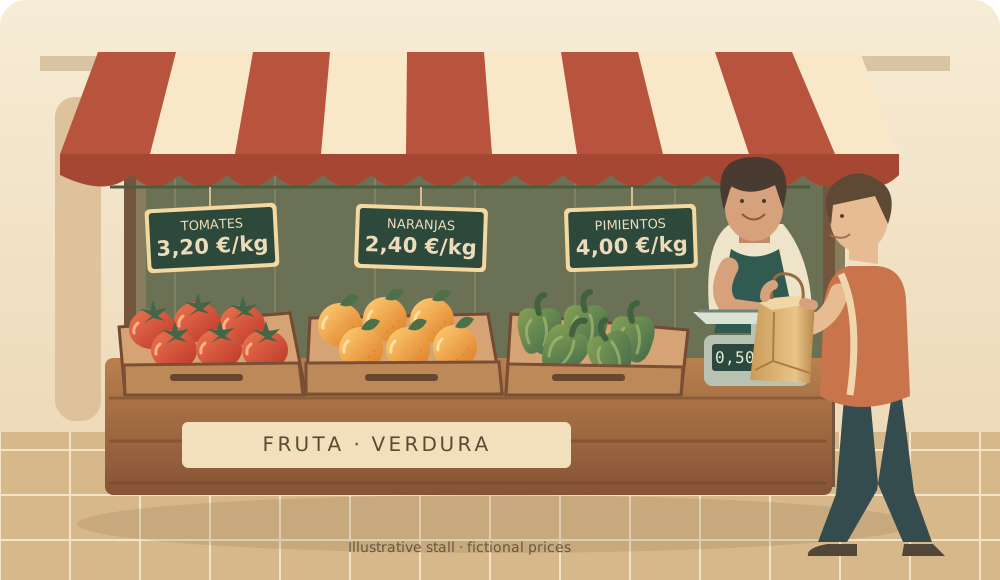
A sign says Tomates: 3,20 €/kg. You want enough for a salad, not a whole kilo. Wait for your turn, then say Medio kilo de tomates, por favor. That means “Half a kilo of tomatoes, please”: 500 grams, costing 1,60 € at this fictional price. The same pattern works for oranges, peppers, and other produce sold by weight.
Find your turn before you order
At a busy puesto (stall), customers may stand around the counter rather than in one straight line. Ask the waiting group ¿Quién es el último? (“Who is last?”). Someone may answer Yo (“Me”). You now know whom you follow; keep track of that person, not just the empty space beside the scale.
¿Quién es la última? is the feminine version, useful when the people waiting are women. Your own gender does not determine the question. If somebody later asks, answer Soy el último or Soy la última, matching yourself. At a stall with numbered tickets, take a number instead. Follow the system actually in use.
Kilos, quarters, and one traditional extra
You do not have to order a kilogram just because the sign gives a kilo price. Put the amount before de and the food name. Un kilo de naranjas is a kilo of oranges; un cuarto de kilo de pimientos is 250 grams of peppers.
- Un kilo
- 1,000 g · one kilogram
- Medio kilo
- 500 g · half a kilogram
- Un cuarto de kilo
- 250 g · a quarter-kilo
- Cuarto y mitad
- 375 g · a quarter plus half that quarter
In a clear food-ordering context, un cuarto can mean a quarter-kilo. Cuarto y mitad is a traditional expression worth recognising, not a phrase you must use everywhere. It means 250 + 125 = 375 grams, not 750 grams. Usage varies; for an unambiguous request, say Trescientos setenta y cinco gramos, por favor. The RAE explains the fraction; Longman gives the 375-gram translation.
Check what the price buys
El kilo means “per kilogram”; la unidad or la pieza means “per item.” A bandeja is a tray and a manojo a bunch. A tray price is not automatically a kilo price. Look at the sign for the particular product, including its variety, rather than borrowing the price from the next crate.
For loose goods weighed in front of you, Spain's price-display rules require a unit price. If the label is unclear, ask ¿A cuánto está el kilo? (“How much is a kilo?”) or ¿Es por kilo o por unidad? (“Is that per kilo or per item?”). Spanish signs commonly use a decimal comma: 3,20 € is three euros and twenty cents.
Your practice basket
Change the stall and the weight
These invented prices teach the calculation, not today's cost of shopping. Each example below remains readable without the chooser.
Tomates · 3,20 €/kg
Medio kilo de tomates, por favor.
500 g × 3,20 €/kg = 1,60 €.
Naranjas · 2,40 €/kg
Un kilo de naranjas, por favor.
1,000 g × 2,40 €/kg = 2,40 €.
Pimientos · 4,00 €/kg
Un cuarto de kilo de pimientos, por favor.
250 g × 4,00 €/kg = 1,00 €.
Medio kilo de tomates, por favor.
500 g × 3,20 €/kg = 1,60 €
Fictional price · exact selected weight
Who picks the fruit? Ask at that stall
Some sellers choose and weigh your order; some stalls let customers select it. Do not assume that every open crate is self-service. Ask ¿Puedo cogerlos yo? (“May I pick them myself?”), referring to tomatoes or peppers. For oranges, use cogerlas. Follow any instructions about bags or handling.
Tell the seller when you will eat the fruit. Los quiero para mañana, no muy maduros. means “I want them for tomorrow, not too ripe.” For tomatoes to eat now, try ¿Tiene tomates maduros para hoy? (“Do you have ripe tomatoes for today?”). Maduro means ripe; verde can mean unripe, but also simply green, so name your purpose rather than relying on colour alone.
Listen for the follow-up, not just the total
Customer: Buenos días. Medio kilo de tomates, por favor.
Seller: ¿Para ensalada? — “For salad?”
Customer: Sí, para hoy. — “Yes, for today.”
Seller: Hay un poco más. ¿Lo dejo? — “There's a little extra. Shall I leave it?”
Customer: Sí, está bien. ¿Cuánto es? — “Yes, that's fine. How much is it?”
Seller: Son quinientos cincuenta gramos. Uno con setenta y seis. ¿Algo más?
Customer: Nada más, gracias. — “Nothing else, thank you.”
At our fictional 3,20 €/kg, 550 grams costs 1,76 €. A little extra changes the total because you pay for the actual weight. To decline, say Un poco menos, por favor (“A little less, please”). ¿Algo más? means “Anything else?”, not a question about the weight. If you lose the number, ask ¿Me lo puede repetir más despacio? (“Could you repeat that more slowly?”).
Pay and take your shopping
¿Se puede pagar con tarjeta? asks whether cards are accepted. Check before ordering if you have no cash. Llevo bolsa means “I've brought a bag”; ¿Me da una bolsa, por favor? asks for one. Finish with Gracias, hasta luego. For opening times and payment arrangements, check the market or stall itself, not a supposed rule for all Spain.