Everyday Spanish · A1–B1
You can see the bread behind the counter, but the person serving is already waiting. Start with Hola. Una barra, por favor. (Hello. One long loaf, please.) Add a pastry if you want one, then answer ¿Algo más? with No, nada más. Gracias. That is enough for a complete bakery order; the rest helps when the loaf, filling, or quantity needs explaining.
Which shop: panadería or pastelería?
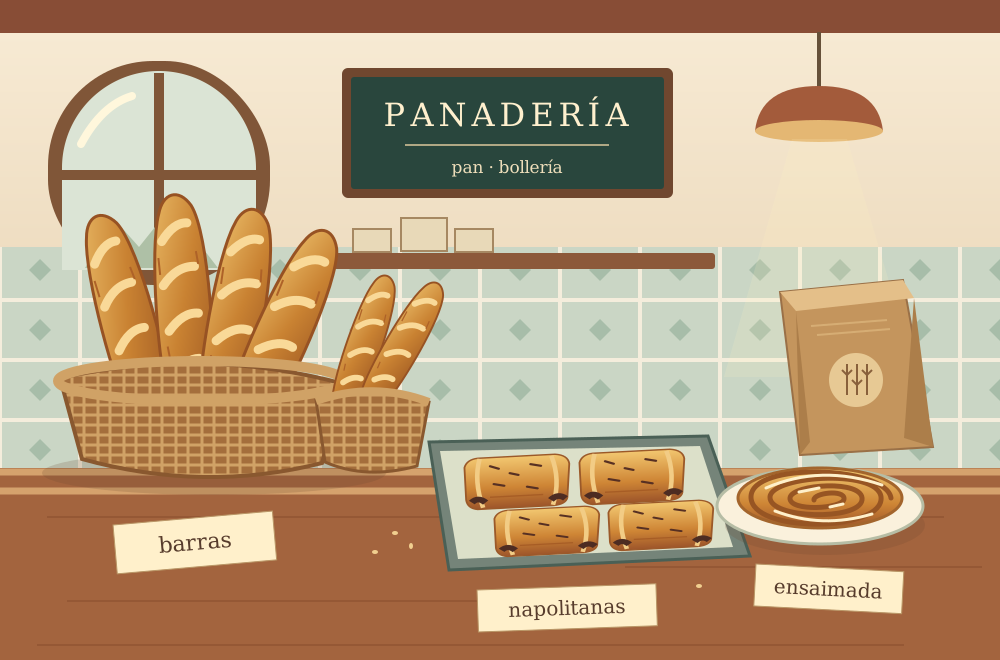
A panadería makes or sells bread. A pastelería makes or sells cakes, pastries and other sweets. These are useful distinctions, not separate worlds: a shop may sell both. Bollería is a useful word for pastries such as croissants and napolitanas. Look at the counter rather than assuming that every bakery has the same range or serves coffee.
Greet the person serving with Hola or Buenos días. If it is unclear who is next, ask ¿Quién es el último? (Who is last in line?). Where there is a ticket machine, take a number. Neither system needs a complicated conversation; establish your turn before starting your order.
Recognise these three counter staples
- Una barra de pan
- A long loaf of bread. Una barra, por favor works when the choice is obvious. If several kinds are displayed, point and say Una de estas, por favor (One of these, please). A barra is a shape, not a guarantee of a particular weight or recipe.
- Una napolitana de chocolate
- A folded, usually rectangular pastry with chocolate inside. Specify the filling: de chocolate means chocolate-filled; de crema means custard-filled. Do not assume that a golden pastry is plain simply because you cannot see its centre.
- Una ensaimada
- A spiral-shaped sweet pastry associated especially with Mallorca, in the Balearic Islands. You may find it elsewhere, but it is not every town's local speciality. Traditional Ensaimada de Mallorca contains pork lard; an unfilled pastry is not necessarily vegetarian. Ask about the actual product if ingredients matter.
For a filling you cannot identify, ask ¿De qué está rellena? (What is it filled with?). For an unfamiliar pastry, ¿Cómo se llama esto? means “What is this called?” Pointing plus a short question is more useful than guessing a name.
Say how many, then say what
Use number + item + por favor. Try Dos barras, por favor (Two long loaves, please) or Tres napolitanas de chocolate, por favor (Three chocolate pastries, please). These nouns are feminine, so one is una, not un. For a mixed order: Una barra y dos napolitanas de crema, por favor. (One long loaf and two custard pastries, please.)
For small biscuits or sweets sold by weight, Doscientos gramos de estas, por favor means “Two hundred grams of these, please.” First check how that product is sold. Media docena means half a dozen: six pieces, not half a pastry. To ask for sliced bread, say ¿Me lo puede cortar en rebanadas? (Could you slice it for me?). Slicing depends on the loaf and the shop.
Counter practice
Build your bakery order
Choose a basket, then decide whether to pack the pastries separately. These are practice exchanges, not a live menu. Without the controls, you can read all three orders below.
One loaf, sliced
Customer: Hola. Una barra, por favor. Hello. One long loaf, please.
Assistant: ¿Esta?This one?
Customer: Sí. ¿Me lo puede cortar en rebanadas? Yes. Could you slice it for me?
Assistant: Claro. ¿Algo más?Of course. Anything else?
Two loaves and a chocolate pastry
Customer: Dos barras y una napolitana, por favor.Two long loaves and one napolitana, please.
Assistant: ¿De chocolate o de crema?Chocolate or custard?
Customer: De chocolate, por favor. Chocolate, please.
Assistant: ¿Algo más? Anything else?
Two small ensaimadas
Customer: ¿Tiene ensaimadas pequeñas?Do you have small ensaimadas?
Assistant: Sí, estas son sin relleno.Yes, these are unfilled.
Customer: Me llevo dos, por favor.I'll take two, please.
Assistant: Muy bien. ¿Algo más?Very good. Anything else?
Your closing line
No, nada más. Gracias. No, nothing else. Thank you.
Nada más. ¿Me lo puede poner en bolsas separadas, por favor?Nothing else. Could you put it in separate bags, please?
Listen for the follow-up, not just your own line
¿Algo más? means “Anything else?”, not “Would you like more of the same?” Add another item with Sí, y una napolitana de crema (Yes, and a custard pastry). To finish, use Nada más, gracias. If you hear ¿Cuántas?, the person is asking “How many?” Reply Dos, por favor; you do not need to repeat the whole order.
¿Para llevar? means “To take away?” Answer Sí, para llevar. You are more likely to need this distinction in a bakery with seating than at a bread-only counter. If the reply goes too fast, say Más despacio, por favor (More slowly, please) or ¿Puede repetir? (Could you repeat that?).
Check ingredients and pay
For ingredients, ask directly: ¿Lleva manteca de cerdo? (Does it contain pork lard?) or ¿Lleva frutos secos? (Does it contain nuts?). For an allergy, explain it and ask about cross-contact; appearance and an ingredient name alone cannot establish that something is safe.
¿Cuánto es? means “How much is it?” To ask about card payment, use ¿Puedo pagar con tarjeta? (Can I pay by card?). Finish with Gracias. Hasta luego. (Thank you. See you later.)
Use the same pattern at your next stop
For a drink with your pastry, continue with ordering coffee and breakfast in Spain. Quantities and pointing also help when shopping at food markets in Spain.
Practise reading everyday exchanges in the Spanish short-story library, or sign up for a free weekly Spanish story at your level.