Holding a bag of apples and wondering whether to weigh it? Ask ¿Tengo que pesar la fruta aquí? (“Do I have to weigh the fruit here?”). In Spanish supermarkets, the answer depends on the shop: you may print a label yourself, get help at the produce counter, or leave the weighing to the cashier.
For a small shop in Spain, learn the signs first, then the questions you will hear back. These four stages take you from finding milk to paying, with short exchanges you can adapt. The prices and signs below are examples, not live store information.
The words on your route
- cesta / carrito
- basket / shopping trolley
- pasillo / sección
- aisle / department
- báscula / etiqueta
- scale / label
- turno / número
- turn / queue number
- caja / bolsa
- checkout / bag
- ticket / tarjeta / efectivo
- receipt / card / cash
Una caja can also mean a box; here it means the checkout. Similarly, tarjeta needs context: a supermarket loyalty card and a bank card are both cards, but the cashier is asking two different things.
A basket of milk, apples and ham
Practise one shopping trip
Read each exchange and its translation. In step mode, choose an answer, then move on; you can also show the whole trip.
Stage 1 / Find it
Ask where, then listen for directions
Look for lácteos (dairy), congelados (frozen food), and frutas y verduras (fruit and vegetables). If you cannot find something, Perdone (“Excuse me”) gets a staff member’s attention before your question.
You: ¿Dónde está la leche?
Where is the milk?
Staff: En el pasillo tres, al fondo, a la derecha.
In aisle three, at the back, on the right.
A la izquierda means “on the left”; junto a means “next to.” For more than one item, change está to están: ¿Dónde están los huevos? (“Where are the eggs?”).
Staff say al fondo, a la derecha. Where do you go?
Stage 2 / Weigh it
Fruit: follow this shop’s system
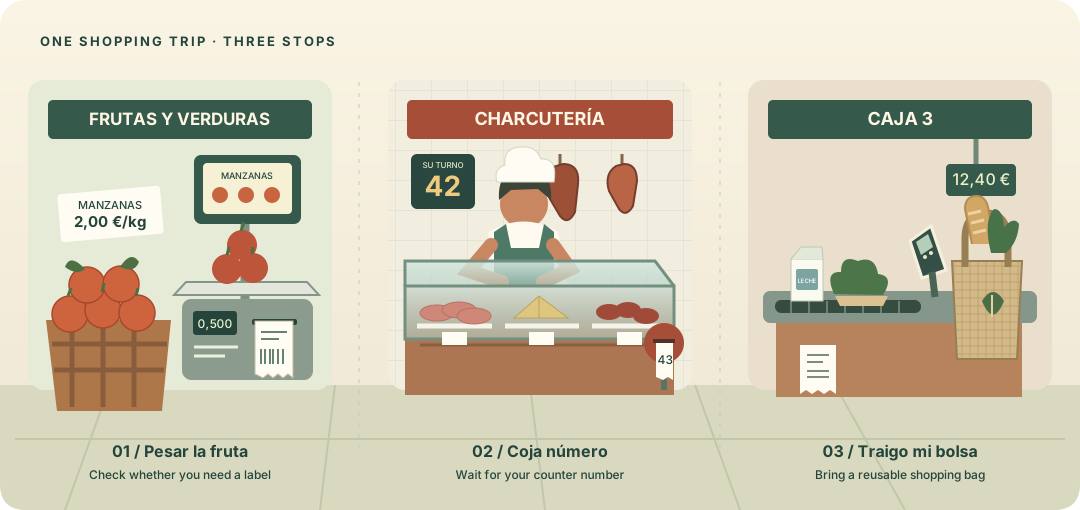
A granel means loose, rather than pre-packed. If the sign says Pese aquí su fruta (“Weigh your fruit here”), use the customer scale. Place one type of produce on it, select the matching item or product code, and attach the printed etiqueta to the bag. Keep different products separate.
Other shops weigh loose produce at the checkout. A scale in the fruit section may only let you check the weight, so its presence alone is not proof that you need a label. Pre-packed produce may already have one; items priced por unidad are sold per piece.
You: ¿Tengo que pesar la fruta aquí?
Do I have to weigh the fruit here?
Staff: No, se pesa en caja.
No, it is weighed at the checkout.
The other answer could be Sí, en esa báscula (“Yes, on that scale”). On shelf labels, distinguish €/kg from a pack price: at an illustrative 2,00 €/kg, half a kilo costs 1,00 €. The comma marks the decimal.
In this exchange, staff say se pesa en caja. What next?
Stage 3 / Take a number
Choose the counter before joining its queue
Charcutería is the deli counter for cold cuts and cured meats, often also cheese. Carnicería sells fresh meat; pescadería sells fish and seafood. Packaged versions may be available elsewhere without counter service.
Where there is a numbered queue, look for Su turno (“Your turn”) or Coja número (“Take a number”). Take a ticket for the correct department and watch the display. This queue ticket is not your payment receipt. Without a machine, ¿Quién es el último? means “Who’s last?”
Staff: ¿El cuarenta y dos?
Number forty-two?
You: Doscientos gramos de jamón cocido, por favor.
Two hundred grams of cooked ham, please.
Staff: ¿En lonchas finas? ¿Algo más?
In thin slices? Anything else?
You: Sí, finas. Nada más, gracias.
Yes, thin. Nothing else, thank you.
You want sliced cooked ham. Which department fits?
Stage 4 / Pay
Loyalty card, bag, payment, receipt
Caja cerrada means “Checkout closed”; solo tarjeta means “card only.” Choose a suitable lane. The cashier may shorten questions to just ¿Bolsa? (“Bag?”) or ¿Ticket? (“Receipt?”).
Cashier: ¿Tiene la tarjeta del supermercado?
Do you have the supermarket’s loyalty card?
You: No, no la tengo.
No, I don’t have it.
Cashier: ¿Necesita una bolsa?
Do you need a bag?
You: No, gracias. Traigo mi bolsa.
No, thank you. I’ve brought my own bag.
Cashier: ¿Con tarjeta o en efectivo?
By card or in cash?
You: Con tarjeta, por favor.
By card, please.
Cashier: Acerque la tarjeta. ¿Quiere el ticket?
Hold your card near the reader. Would you like the receipt?
You: Sí, gracias.
Yes, thank you.
For cash, say En efectivo, por favor. If you need a bag, say Una bolsa, por favor. Expect a charge for a checkout carrier bag, but check its displayed price. Spain’s plastic-bag rules depend on bag type and include exceptions; there is no single price for every bag in every shop. Bringing a reusable bag avoids needing to buy one.
The cashier asks ¿Quiere el ticket?. What are they offering?
If the reply is too fast
¿Puede repetirlo más despacio, por favor? means “Could you repeat that more slowly, please?” Use it as soon as you lose the thread. At the checkout, listen again for the key noun: bolsa, tarjeta or ticket.
Buying from individual stalls instead? Read about shopping at food markets in Spain. For bread-counter exchanges, try how to order at a bakery in Spain.