Barcelona phrase walk · A1–B1
You can point at the snack you want. The harder moment comes when the seller asks a question back. ¿Para llevar? means “To take away?” A simple Sí, para llevar, por favor. finishes that exchange. For a walk around La Rambla and La Boqueria, prepare a direction question, a way to check a price, and a short order. You do not need a speech.
La Rambla or Las Ramblas?
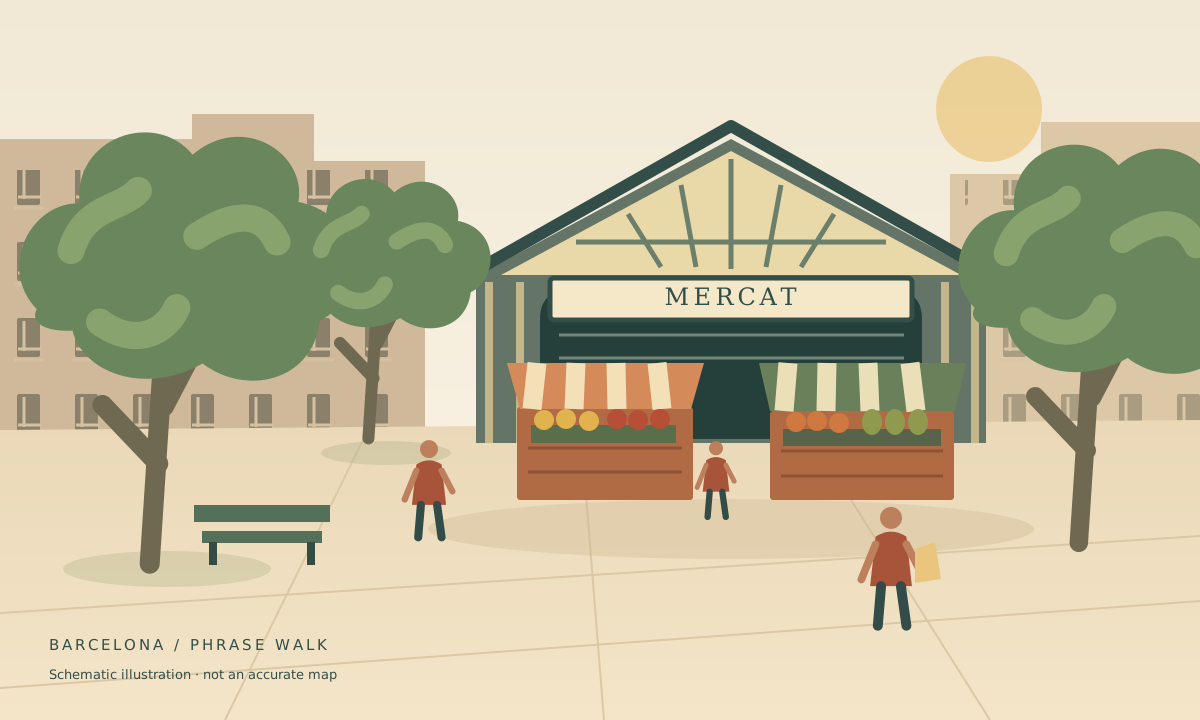
La Rambla and Las Ramblas name the same boulevard, divided into five named stretches. In Catalan, you may see les Rambles. La Boqueria, its food market, is also called Mercat de Sant Josep.
Along the way are flower stalls and the Liceu opera house. Try Vamos a pasear por la Rambla — “Let's go for a stroll along La Rambla.”
Five situations · no fixed route
Build your phrase-stop walk
Choose a stop to jump to its conversation. Read the Spanish aloud, check the English, then cover the translation and try again. Every conversation stays on the page. These are practice exchanges, not quotations from market staff.
Stop 01 / orientation
Ask for the entrance
You: Perdone, ¿dónde está la entrada del mercado?
Excuse me, where is the market entrance?
Possible reply: Está por allí.
It's over there.
You: ¿Por aquí? Gracias.
This way? Thank you.
Listen for a la derecha (on the right), a la izquierda (on the left), and todo recto (straight ahead). Those are vocabulary items, not directions to La Boqueria here. If the answer is vague, show the place name on your phone rather than guessing.
Notice the difference between ¿Dónde está…? (Where is…?) and ¿Cómo llego a…? (How do I get to…?). The first asks for a location; the second invites directions. Start with the shorter question if you only want someone to point. Use Perdone to get an unfamiliar adult's attention politely, then pause so they can respond.
Stop 02 / two languages
Read what is actually written
Barcelona uses both Catalan and Spanish, two distinct languages. Learning a few equivalents helps when the street sign uses one language and your guide uses the other. Start with these three:
- English
- Spanish / Catalan
- Market
- mercado / mercat
- Street
- calle / carrer
- Exit
- salida / sortida
¿Qué significa esta palabra? means “What does this word mean?” Point to the actual word. You can also ask ¿Podemos hablar en español? (Can we speak in Spanish?). Acknowledge the answer without assuming which language someone prefers.
For an unfamiliar food label, ask what the product is and what it contains. If the seller points to another sign, check that too: it may give the quantity, ingredients or price unit.
Stop 03 / before buying
Ask what the price covers
You: ¿Cuánto cuesta esto?
How much does this cost?
Follow-up: ¿Es por unidad o por kilo?
Is that per item or per kilo?
A number alone does not tell you the quantity. Check the unit on the displayed price, especially when comparing loose produce with a prepared portion. Una unidad is one item; una ración is a portion. For a plural question, change cuesta to cuestan: ¿Cuánto cuestan estas manzanas? means “How much do these apples cost?”
Stop 04 / a small order
Order, then answer the follow-up
You: Un bocadillo de queso, por favor.
A cheese sandwich, please.
Seller: ¿Para llevar? ¿Algo más?
To take away? Anything else?
You: Sí, para llevar. Nada más, gracias.
Yes, to take away. Nothing else, thank you.
Use this order only if the stall actually offers that sandwich. Un bocadillo usually means a sandwich made with a bread roll or baguette-style bread. Do not infer ingredients from the name alone. Ask ¿Qué lleva? (What's in it?). For allergies, name the allergen and confirm suitability before buying; a short translation cannot guarantee that food is safe.
To ask whether an item is available, use ¿Tiene bocadillos? (Do you have sandwiches?). If the answer is no, ¿Qué tiene? asks “What do you have?” When paying, ¿Puedo pagar con tarjeta? means “Can I pay by card?” Wait for confirmation rather than assuming a payment method. En efectivo means “in cash.” These questions work independently: you can check payment before you order.
Stop 05 / keep the conversation going
Slow down the answer
¿Puede repetirlo más despacio, por favor? means “Could you repeat it more slowly, please?” You can shorten it to Más despacio, por favor. when you need the words quickly.
Try a two-person rehearsal: one person asks the price, the other gives a number, then the first asks for repetition. Switch roles. At A1, keep the short request; at A2, add the unit question; at B1, explain Estoy aprendiendo español y no he entendido el precio. (I'm learning Spanish and I didn't understand the price.) Repairing one missed detail is more useful than pretending to understand the whole answer.
For a final memory check, look away from the page and say three things: where you want to go, what you want to buy, and what you need repeated. Then change just one detail in each sentence. Replace “market” with “exit,” or “cheese” with an ingredient you recognise on the actual menu. Keep the sentence frame; you do not have to rebuild the whole conversation.
Take the phrases into another scene
Practise a different setting with Spanish for La Barceloneta beach, build a longer order with shopping at food markets in Spain, or rehearse ordering coffee and breakfast.
Keep reading with translations and audio in the Spanish short-story library, or get a free weekly Spanish story at your level.