To ask to join beach volleyball in Barcelona, try Hola, ¿puedo jugar con vosotros? (Hi, can I play with you?). To ask about bathing conditions, use ¿Qué significa esta bandera? (What does this flag mean?). For lunch, start with ¿Tenéis una mesa para dos? (Do you have a table for two?). These short questions give you a way into a conversation without needing a long speech.
Which beach are you talking about?
La Barceloneta names a neighbourhood as well as a beach. Barcelona City Council identifies Barceloneta beach as the stretch from Almirall Cervera street to the Gas breakwater. Sant Miquel and Somorrostro are separate beaches, not alternative names for every piece of sand along the waterfront. When meeting someone, agree on a named place rather than just saying “the beach.”
Barcelona has two official languages, Catalan and Spanish. You will see platja on signs: it means “beach,” like Spanish playa. Keep local place names as you find them. Spanish is useful for the exchanges below; recognising a few Catalan words also helps you read the signs around you.
Joining a game means asking, not claiming a place
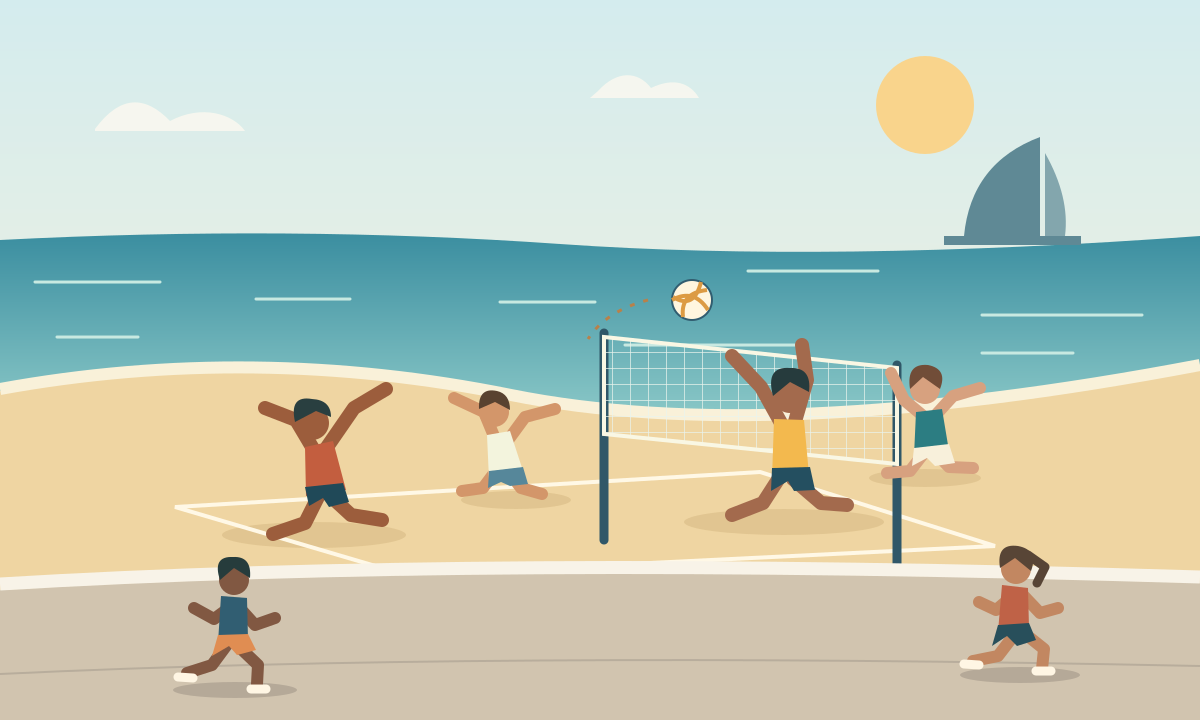
Wait for a break in play and speak from outside the court. ¿Os falta alguien? means “Are you short of a player?” It asks about the group's needs rather than assuming you can step in. If you are learning, add Soy principiante (I'm a beginner). A group may be training, finishing, or playing with friends; a refusal is not a language failure.
The council lists volleyball facilities at Barceloneta, though you may need to bring equipment and wait for a space. Its casual-sports guidance limits play to signposted designated areas during the mid and high bathing seasons. Check the current signs and official guidance before setting up, and leave space for other beach users.
Useful game words are el balón (the ball), la red (the net), el saque (the serve), and un punto (a point). Ask ¿Hasta cuántos puntos jugáis? (How many points are you playing to?) instead of assuming the group follows your usual format.
Beach flags: learn the words, follow the staff
Catalonia's official civil-protection guidance gives these meanings. They describe bathing conditions, not the weather forecast:
Green is not a personal safety guarantee, and yellow does not simply mean “small waves.” Currents, water conditions, or other hazards can affect the flag. Check the flag at your actual beach and follow lifeguards' instructions and local signs, even if an online page shows something different. The council says to stay away from breakwaters; this article does not recommend a swimming route. In an emergency, call 112.
Running and cycling: two different sets of words
Salir a correr means “to go for a run”; dar un paseo means “to go for a walk.” El paseo marítimo is the seafront promenade, while el carril bici is a cycle lane. They are not interchangeable spaces. Runners should stay out of cycle lanes and leave room for people walking, stopping, or using mobility aids.
For cycling, ask ¿Dónde está el carril bici? (Where is the cycle lane?). Follow the signed cycling network rather than treating a wide promenade as permission to ride anywhere. Current council guidance generally prohibits pavement cycling, with specified exceptions, and requires dismounting in crowded pedestrian spaces where cycling is permitted. Check the council's current cycling guidance for the details; local signs still matter.
¿Podemos ir más despacio? means “Can we go more slowly?” It works with a running partner without turning the conversation into a complaint. If you stop to check directions, move out of other people's way first.
Lunch questions worth asking before you order
La carta is the menu listing individual dishes. El menú del día is a set daily meal when offered; check what is included. For a rice dish, ask ¿El precio es por persona? (Is the price per person?) and ¿Hay un mínimo de personas? (Is there a minimum number of people?). Do not assume every restaurant serves the same dishes or portions.
Order agua sin gas for still water or agua con gas for sparkling. If you have an allergy, state it before choosing and confirm with staff what can be prepared safely. To finish, La cuenta, por favor means “The bill, please.” For more food vocabulary, read how to order tapas in Spain; for another Barcelona conversation setting, try La Rambla and La Boqueria Spanish.