Galicia · A table-side Spanish guide · A1–B1
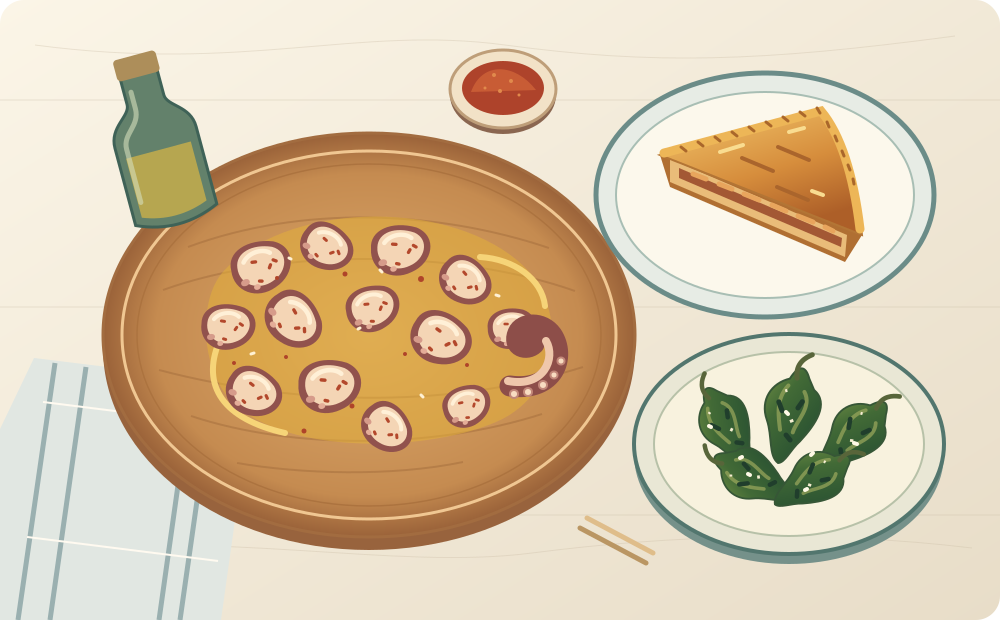
A wooden platter, rounds of octopus, red paprika and olive oil: that is the dish to look for when a menu says pulpo a la gallega. To order it, start with Una ración de pulpo, por favor. (A portion of octopus, please.) Then ask whether potatoes come with it: they may accompany the octopus or be ordered separately.
One dish, more than one name
Pulpo is Spanish for octopus; polbo is Galician. You may see polbo á feira, or the familiar menu wording pulpo á feira. The Galician phrase á feira refers to the fair, reflecting the dish's association with fairs and the people who prepare it there. A la gallega is Spanish for “Galician-style”.
The usual starting point is cooked octopus, cut into pieces and dressed with olive oil, coarse salt and pimentón, paprika. Wooden platters are a familiar presentation. You will encounter explanations that distinguish the names by the presence of potatoes, but do not use that as a guarantee. Turismo de Galicia describes á feira with cachelos, cooked potatoes, as a possible accompaniment. Ask what comes on this particular plate.
Read the dish · Ask the question
What is on the table?
Each card pairs a menu clue with a request you can use. Choose an ingredient or dish to concentrate on it, or read all four. The speaker buttons play the Spanish requests.
01 / The platter
Pulpo y patatas
Potatoes might be included, offered separately or absent. Con means “with”; aparte means “separately”. These small words help you understand both the serving and any extra order.
¿El pulpo viene con patatas?
Does the octopus come with potatoes?
02 / The red seasoning
Pimentón
This is ground paprika, not a whole pepper. Dulce identifies the sweet or mild kind; picante means hot. A kitchen may use different kinds or a mixture, so the dish's red colour alone does not tell you how spicy it is.
¿Se puede preparar con pimentón dulce?
Can it be prepared with sweet paprika?
03 / The filled pastry
Empanada gallega
Think of a filled pie, often cut into portions, rather than assuming an individual turnover. Doughs and fillings vary: fish, shellfish and meat all appear. A golden crust cannot tell you what is inside.
¿De qué es la empanada?
What is the empanada filled with?
04 / The green peppers
Pimientos de Padrón
These small green peppers are commonly served fried with coarse salt. Herbón, in the municipality of Padrón, is central to their local tradition. Some peppers are hot and others are not; neither “all fiery” nor “never spicy” is a safe promise.
¿Estos pimientos pican?
Are these peppers hot?
All four dish notes and requests are shown.
A short order, including the follow-up
This practice conversation is one possible exchange, not a prediction of every restaurant's portions or ingredients. Notice how the customer answers the server's question before adding another dish.
Customer: Hola. Una ración de pulpo, por favor.
Hello. A portion of octopus, please.
Server: ¿Para compartir?
To share?
Customer: Sí, para los dos. ¿El pulpo viene con patatas?
Yes, for the two of us. Does the octopus come with potatoes?
Server: No, las patatas van aparte.
No, the potatoes come separately.
Customer: Entonces, una de patatas también. ¿De qué es la empanada?
Then a portion of potatoes too. What is the empanada filled with?
Server: Hoy tenemos de bonito.
Today we have tuna empanada.
Customer: Un trozo, por favor.
A piece, please.
Una de patatas leaves out ración because the context supplies it. If that feels too quick, use the full phrase. Para compartir tells the server your intention; it does not establish that a portion will feed two people. Ask ¿Es suficiente para dos? (“Is it enough for two?”) before deciding how much to order.
Listen for the answer, not just the dish
After your empanada question, listen for de carne (“meat”), de bacalao (“cod”) or another filling. The little word de connects the pastry to what is inside it. You do not need to translate the server's entire sentence to recognise one of these combinations. If the filling is unfamiliar, point to the item and ask ¿Qué lleva? (“What does it contain?”). That question also works when you want the ingredients beyond the main filling.
A reply such as Solo tenemos raciones enteras means “We only have full portions.” Media ración means “half a portion”, but it is not an option everywhere. Check the menu or ask rather than calculating half the printed price yourself. If you hear No nos queda, the dish has run out. You can answer Entonces, ¿qué nos recomienda? (“Then what do you recommend?”). These replies turn a memorised request into a conversation, even when the first thing you wanted is unavailable.
Two languages, not two versions of Spanish
Galician, or galego, is a language in its own right, co-official with Spanish in Galicia. It is used in daily conversation, education, media and public life. Recognising polbo beside Spanish pulpo gives you two ways to spot the same dish on a menu.
The requests here are Spanish. You can explain that you are learning with Estoy aprendiendo español. If you do not understand an answer, ask for help rather than guessing which language someone should use.
¿Puede repetirlo más despacio, por favor?
Could you repeat that more slowly, please?
Ask before changing the order
If the server answers your pepper question with Unos sí y otros no, that means “Some are, and others aren't.” Asking cannot make every pepper mild. If you need to avoid heat, explain No puedo comer picante (“I can't eat spicy food”) and ask what else is available. A request for sweet paprika is likewise a question, not a guarantee that the kitchen can change a prepared dish.
For allergies, name the allergen and ask the staff to confirm ingredients and preparation, including cross-contact. Do not use a dish name, a photograph or this guide as a safety check. Empanada fillings and doughs especially need more than a glance.
For the rest of the meal, see how to order at a restaurant in Spain. Compare portion vocabulary with ordering tapas, or read about pintxos in San Sebastián without assuming the same serving customs apply in Galicia.
Take one question into your next story
Practise ¿De qué es…? for a filling and ¿Viene con…? for an accompaniment. Read Webbu's Spanish short stories with translations and audio, or get a free weekly Spanish story at your chosen level.