Spanish at the counter · A1–B1
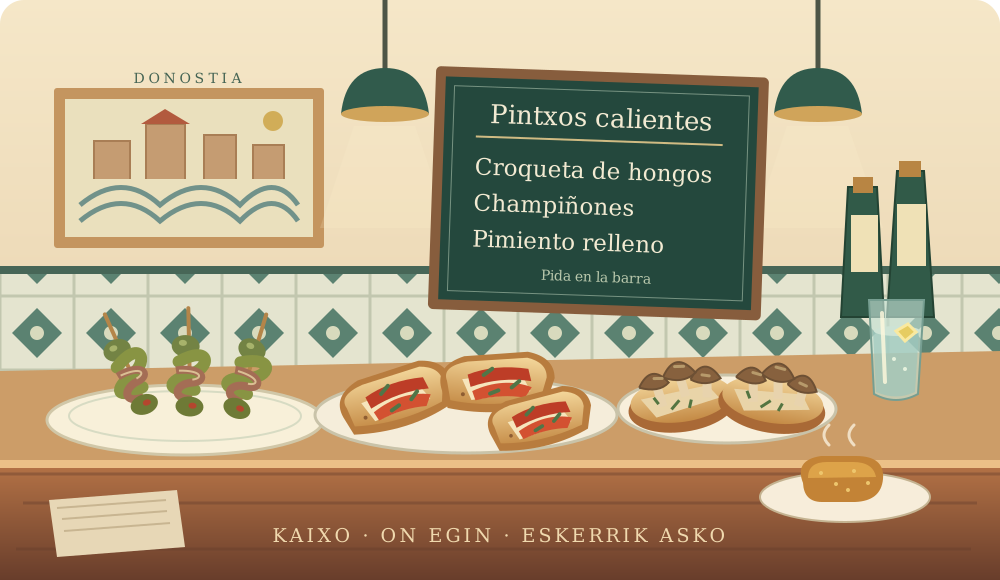
A gilda sits beside slices of bread topped with peppers; a chalkboard lists hot dishes behind the counter. Which do you order, and which can you take? Greet the server, ask how the counter works, order hot pintxos from staff, and check when to pay. Start with Hola, ¿me sirve usted o puedo coger uno? (“Hello, do you serve me, or can I take one?”). You do not need to guess the system.
Pintxos, not a set of tapas rules
In Donostia/San Sebastián, the Spanish phrase ir de pintxos means going out for small bites, often trying different bars. The Parte Vieja (Old Town) and Gros are well-known areas for it. One or two pintxos at a stop leaves room to try another place, but moving on is an option, not an obligation.
A traditional pintxo might be food held to bread with a small skewer. Today, it can also be a croquette, a mushroom dish, or a small creation served on a plate. A gilda typically combines an olive, anchovy and pickled green pepper. It contains fish, even though the green ingredients stand out.
The boundary between pintxo and tapa is not a reliable ordering rule. Do not assume that every pintxo has bread or a stick, or that a tapa elsewhere is always free. Here, expect to pay for what you order; check the menu or ask ¿Cuánto cuesta este pintxo? (“How much is this pintxo?”). For wider context, see how to order tapas in Spain.
Before you reach for the food
The city and provincial tourism guides describe cold pintxos on the counter and hot ones ordered from staff. Some counters allow self-service; others have staff plate your choices. Ask before picking anything up, even if the food is within reach. Pointing and saying Este, por favor. (“This one, please.”) works when you cannot name it.
Wait for the server's attention without blocking someone collecting food. A hot order may arrive later than your drink; ask where to wait if you are unsure. The board might say pintxos calientes (“hot pintxos”). Ask ¿Qué pintxo caliente recomienda? (“Which hot pintxo do you recommend?”). Confirm the quantity before accepting a larger ración, or portion.
Your turn at the barra
Choose your counter conversation
These invented exchanges show possible replies, not one bar's policy. Choose food first, then a payment routine. Without the controls, read both alternatives and borrow the lines you need.
You: Hola, ¿me sirve usted o puedo coger uno?
Hello, do you serve me, or can I take one?
From the counter
Server: Se lo sirvo yo. ¿Cuál quiere?
I'll serve it for you. Which one would you like?
You: Una gilda, por favor.
One gilda, please.
Server: ¿Algo para beber?
Anything to drink?
Something hot
You: Una croqueta de hongos, por favor.
One mushroom croquette, please.
Server: Tarda unos diez minutos. ¿Le parece bien?
It takes about ten minutes. Is that OK?
You: Sí, gracias. ¿Dónde espero?
Yes, thanks. Where do I wait?
You: Un agua con gas, por favor.
A sparkling water, please.
You: ¿Pago ahora o al final?
Do I pay now or at the end?
If the server says “at the end”
Server: Al final. Luego me dice lo que ha tomado.
At the end. Tell me later what you've had.
You, before leaving: Me cobra, por favor. Una gilda y un agua con gas.
I'd like to pay, please. One gilda and a sparkling water.
Chose the hot branch? Replace una gilda with una croqueta de hongos. Name what you actually had.
If the server says “now”
Server: Ahora, por favor.
Now, please.
You: ¿Puedo pagar con tarjeta?
Can I pay by card?
Server: Sí. Aquí tiene el recibo.
Yes. Here's your receipt.
A drink is your choice
Txakoli is a Basque wine, commonly white; it is an alcoholic drink, not a requirement for eating pintxos. If you want it, try Un txakoli, por favor. A zurito is a small beer, and a txikito a small glass of wine. These are useful words to recognise even if you order neither.
For a non-alcoholic order, ask for agua sin gas (still water), agua con gas (sparkling water), or un refresco (a soft drink). ¿Qué tienen sin alcohol? means “What do you have without alcohol?” Choose an actual drink rather than assuming a particular alcohol-free beer is stocked.
Two questions worth asking before ordering
¿Qué lleva? means “What's in it?” Use it before choosing something unfamiliar. ¿Lleva pescado? asks whether it contains fish. Mushrooms or peppers on top do not establish that the whole pintxo is vegetarian. For allergies, state the allergy explicitly and ask staff about ingredients and cross-contact; appearance and a brief vocabulary list cannot establish safety.
If the reply comes too fast, use Más despacio, por favor. (“More slowly, please.”). If you only catch a number, confirm ¿Diez minutos? (“Ten minutes?”). Repeating the key detail gives the server something specific to correct.
Basque words belong to a living language
You will encounter Spanish and Basque, also called euskara. Basque is not a form of Spanish. Kaixo means “hello”; eskerrik asko means “thank you”; agur means “goodbye”. The city's tourism dictionary includes recordings if you want to hear them.
A Basque greeting can sit alongside a Spanish order. If you need to explain which language you are learning, say Estoy aprendiendo español. You can also ask ¿Podemos hablar en castellano? (“Can we speak in Spanish?”).
Check the bill, not the sticks
Paying at the end is common in the local guides, but follow the bar's instructions. Some staff keep a running account; a server may instead ask what you consumed. Remember the dishes and drinks, including later additions, and keep any order slip. A pile of toothpicks is not a universal billing system: plenty of pintxos have no stick at all.
At a counter, Me cobra, por favor. is a natural way to ask to settle up. Check card payment rather than assuming it, and clarify who is paying if you are with friends. For a seated meal, practise asking for the bill in Spain. For another regional food conversation, try pulpo and eating in Galicia.
Keep reading in Spanish
From one order to a whole conversation
Read with translations and audio in the Spanish short-story library, or get a free weekly Spanish story at your level.