Track Your Vocabulary While You Read
One of the biggest challenges in language learning is keeping track of all the new words you encounter. You read a story, look up a dozen words, and by the next day half of them have slipped away. Sound familiar?
No flashcard apps, no notebooks, no copying words into spreadsheets. You just read, click the words you don't know, and your vocabulary builds itself.
That's exactly the problem vocabulary tracking solves. Every time you click a word in a story on Webbu, it's automatically saved to your personal vocabulary. You just read, click the words you don't know, and your vocabulary builds itself.
How It Works
When you're reading a story in German, French, or Spanish, you can click on any word to see its translation, along with useful grammar details like gender, case, and verb tense. That click does two things: it helps you understand the sentence right now, and it saves the word to your personal vocabulary for later.
You don't need to press a separate "save" button or add the word to a list manually. The act of looking it up is enough. If you clicked it, you needed it — and that means it's worth remembering.
The Vocabulary Sidebar
Here's where things get really useful. While you're reading any story, you can open a vocabulary sidebar that sits right next to the text. This sidebar shows all the words you've saved so far — not just from the current story, but from every story you've ever read.
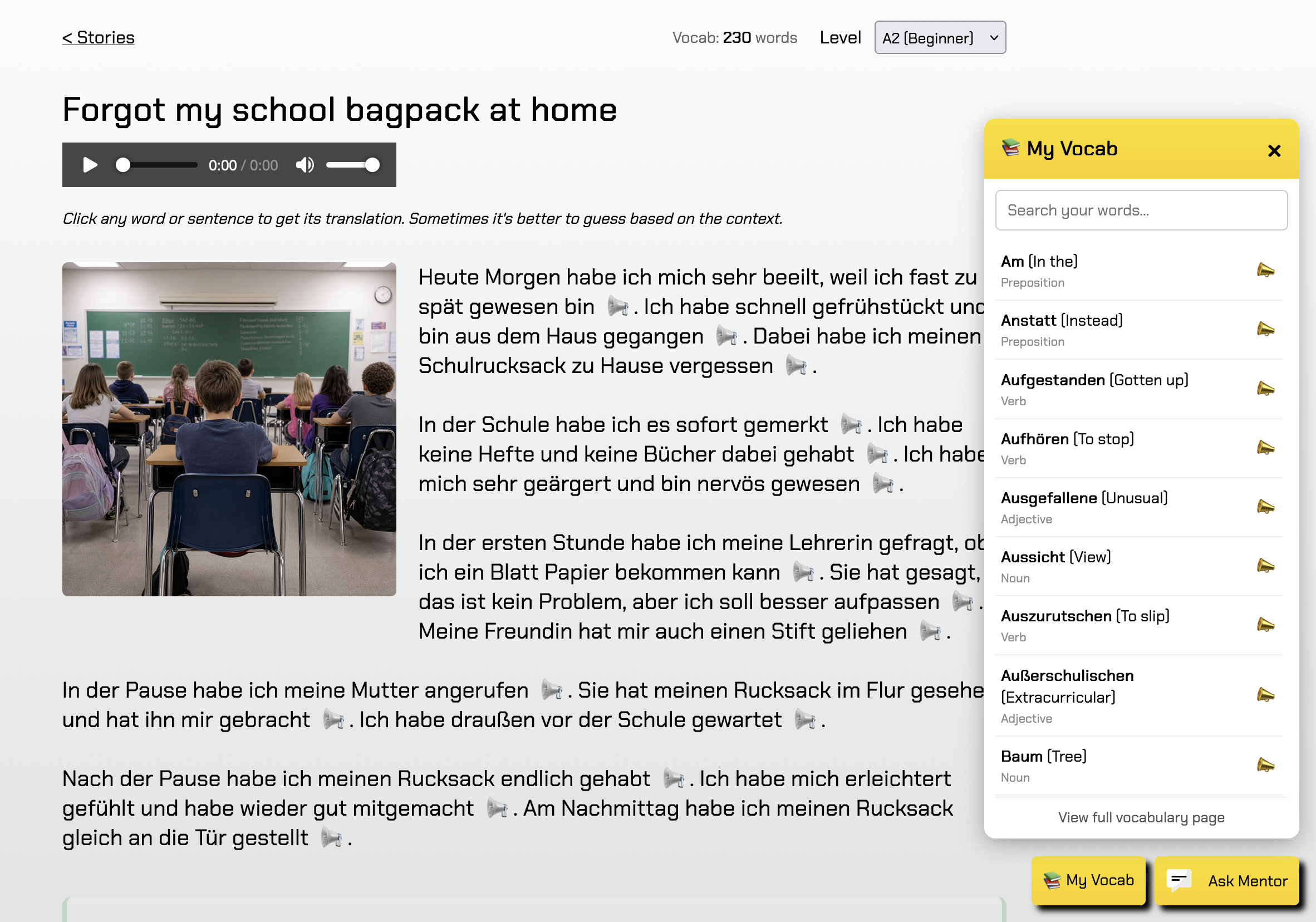
The vocabulary sidebar sits alongside the story, showing your saved words as you read
You can search through your saved words, review their translations, and remind yourself of words you looked up last week or last month. It's like having your own personal dictionary that only contains the words you needed to look up.
Your vocabulary sidebar reflects your learning journey, not a generic word list someone else created.
This matters because everyone's vocabulary gaps are different. A beginner might be looking up basic verbs, while an intermediate learner might be clicking on unusual adjectives or idiomatic expressions.
Your Full Vocabulary Page
Beyond the sidebar, you also have a dedicated vocabulary page where you can see all your saved words organized in one place. This gives you a broader view of everything you've learned. You can scroll through your words, review translations, and see just how much you've picked up over time.
Think of the sidebar as your quick-reference tool while reading, and the vocabulary page as your complete collection for review sessions.
Why Learning Words Through Stories Works
There's a reason vocabulary picked up through reading tends to stick better than words memorized from a list. When you encounter a word in a story, you're not just seeing the word — you're seeing it in context. You know what was happening in the scene, who said it, and why it mattered. That context creates a memory hook that a bare word-and-translation pair simply can't match.
Research in language acquisition consistently shows that incidental vocabulary learning — picking up words naturally while engaged in reading — leads to deeper retention than deliberate memorization alone. When you read a story about someone ordering coffee in a Berlin café, the words for "cup," "milk," and "the bill" attach themselves to a vivid scenario. Next time you're in a similar situation, those words are more likely to surface.
This is also why vocabulary tracking across multiple stories is so powerful. A word you first encountered in a story about a train journey might appear again in a story about a family dinner. Each time you see it in a new context, your understanding of that word deepens. And because Webbu tracks your vocabulary across all stories, you can see which words keep coming up and which ones you've only seen once.
Watch Your Vocabulary Grow
At the top of every story, you'll see a vocabulary count — the total number of words you've saved so far. It's a small number at first, but it grows faster than you'd expect. After just a few stories, you might have 50 or 100 words saved. After a month of regular reading, that number can climb into the hundreds.
That vocabulary count is concrete proof that you're moving forward, one word at a time.
There's something genuinely motivating about watching that counter go up. Language learning can sometimes feel like you're not making progress, especially in the intermediate stage where the easy wins of beginner learning have passed. But that number keeps climbing — and it's all real words you encountered in real context.
Practical Tips for Building Vocabulary
To get the most out of vocabulary tracking, here are a few tips from experienced language learners:
Don't click every word
When you encounter an unfamiliar word, try to guess its meaning from context first. Look at the surrounding sentence, think about what would make sense. Only click on words you truly can't figure out. This way, your saved vocabulary contains the words that actually challenged you.
Re-read stories
Going back to a story you read last week is one of the best ways to reinforce vocabulary. You'll be surprised how many words you remember the second time around, and you can use the sidebar to quickly check any that have slipped.
Read regularly, even if it's short
One story a day — even a short one — does more for your vocabulary than a three-hour study session once a week. Consistency beats intensity when it comes to language learning. Your vocabulary counter rewards that consistency by showing steady growth over time.
Use the sidebar while reading
If you're partway through a story and a word feels familiar but you can't quite place it, open the sidebar and search for it. That moment of recognition — "Oh right, I know this word!" — is exactly how passive vocabulary becomes active vocabulary.
Check your vocabulary page periodically
Once a week, spend five minutes scrolling through your saved words. You don't need to drill them or test yourself. Just reading through the list and seeing the translations is a lightweight form of review that helps keep words fresh.
Vocabulary Tracking Works Across All Stories
One detail worth highlighting: your vocabulary is not tied to a single story. Words you look up while reading a beginner story about grocery shopping will appear in your sidebar when you later read an intermediate story about travelling. This continuity means your vocabulary is always with you, growing alongside your skills as you take on more challenging texts.
You can explore the full collection of stories in the story archive and pick whatever interests you. Every story you read adds to the same vocabulary, building a comprehensive picture of the words you've learned.
Start Building Your Vocabulary Today
The best way to understand how vocabulary tracking works is to try it yourself. Pick a story in German, French, or Spanish, start reading, and click on any word you don't know. Open the sidebar, watch your word count grow, and see how quickly reading turns into real vocabulary.
No word lists to memorize. No pressure to get everything right. Just stories, words, and steady progress.
That's what language learning should feel like.
Get a weekly dose of German Or Spanish for free!
One short story a week, at the level you pick.
No card needed. Unsubscribe in one click.

• Low effort
• Fun
• Real-life texts