Practice Questions: Test What You Really Understood
You just finished reading a short story in German. You understood most of it — or at least you think you did. But here's the uncomfortable question: if someone asked you right now what happened in that story, could you explain it? Could you write it down?
There's a massive gap between feeling like you understood something and actually understanding it. Practice questions exist to close that gap. And on Webbu, we've built two distinct ways to test yourself — both designed to make you produce language, not just passively consume it.
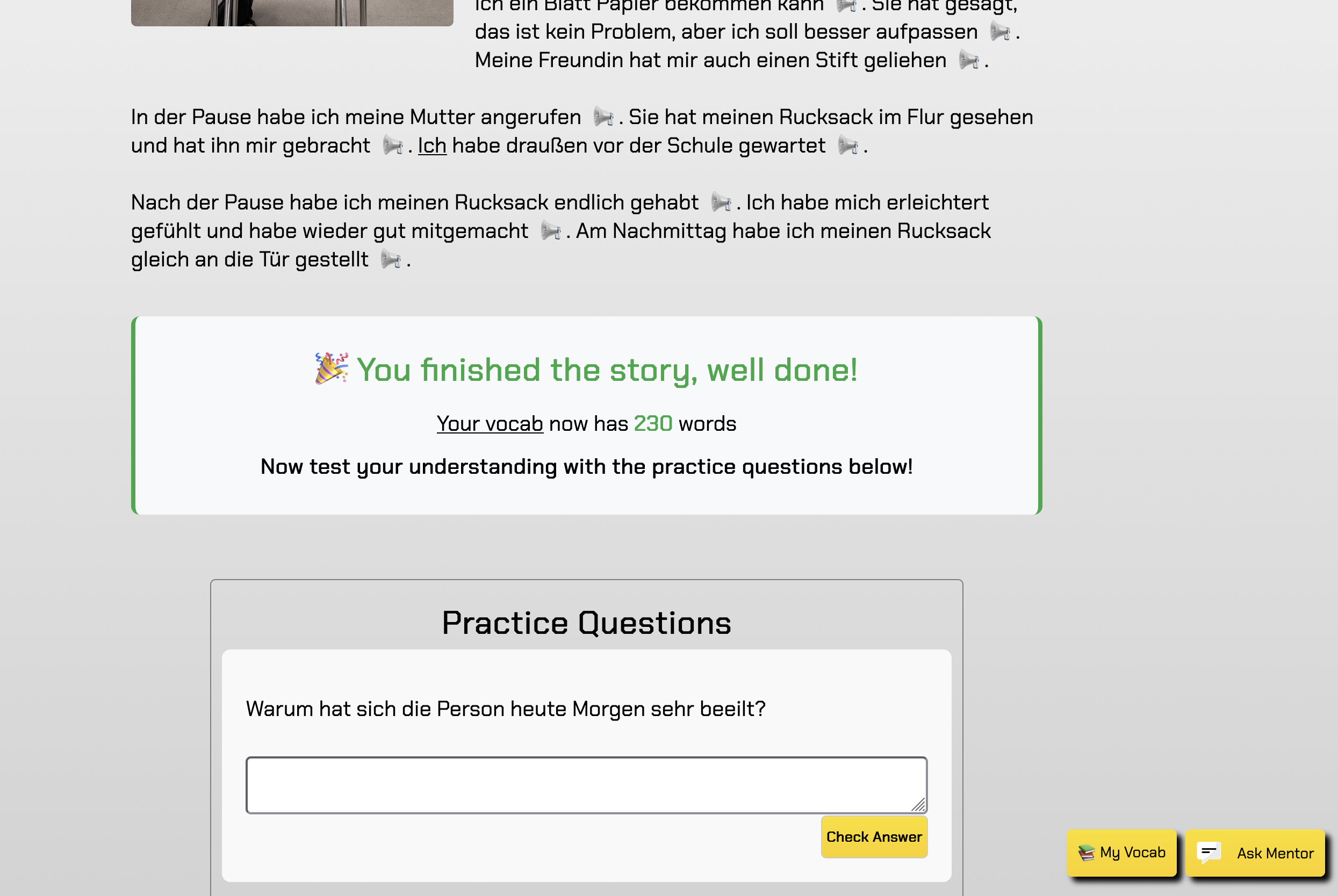
Grammar practice exercises on Webbu — translate sentences, get instant feedback
Why Testing Yourself Beats Re-Reading Every Time
Let's get this out of the way: one of the most well-researched findings in learning science is that active recall — the act of pulling information out of your memory — is dramatically more effective than simply reviewing material again. It's not even close.
When you re-read a passage, your brain recognizes the words and thinks, "Yes, I know this." But recognition is cheap. It creates a false sense of confidence. You see a word like Entschuldigung and think, "Oh yeah, that means excuse me." But could you produce that word from scratch when you actually need it? That's a different skill entirely.
Each time you successfully recall something, the neural pathway gets stronger. Each time you struggle and then find the answer, you learn even more.
Testing yourself forces your brain to retrieve information actively. This is why practice questions after reading are so powerful — they transform passive reading into active learning.
Story Comprehension Questions: Did You Actually Get It?
After you finish reading a story on Webbu, you'll find comprehension questions waiting for you. These aren't generic, cookie-cutter questions pulled from a database. They're about the specific story you just read.
That matters more than you might think. The context is fresh. The vocabulary is still bouncing around in your short-term memory. The characters, the plot, the details — they're all right there. This is the perfect moment to test whether you truly absorbed the material.
Here's how it works: you read the question, and then you write your answer. Not select from a list. Not drag and drop. You type it out. And then you get instant feedback on whether your answer is correct.
This is a deliberate choice. Writing forces production. When you have to formulate a response in the target language — even a short one — you're engaging grammar, vocabulary, and sentence structure all at once. It's harder than multiple choice, and that's exactly the point.
Multiple Choice Is a Crutch (And Here's Why)
Multiple choice questions have their place, but let's be honest about what they actually test: recognition. You see four options, and your brain scans for the one that looks familiar.
You can often guess correctly even when your understanding is shallow. You might eliminate two obviously wrong answers and flip a coin between the remaining two. That's not learning — that's test-taking strategy.
When you have to write an answer from scratch, there's nowhere to hide. You either know the word or you don't. You either understand the grammar or you don't. It's uncomfortable, but that discomfort is where real progress happens.
Think of it this way: recognizing someone's face on the street is easy. But could you describe that face accurately enough for someone else to identify them? That's the difference between recognition and production. Language learning demands both, but production is what separates people who "studied a language for years" from people who can actually use one.
The Grammar Practice Page: Drill the Weak Spots
Story comprehension questions are great for testing understanding in context. But sometimes you know exactly where your weak spots are, and you want to hammer them directly. That's what the practice page is for.
The grammar practice page gives you fill-in-the-blank exercises where you translate English sentences into your target language. But it's not just random sentences. You get to configure exactly what you want to practice:
You type your translation, submit it, and get immediate feedback. No waiting, no ambiguity. You see right away whether you got it right and where you went wrong.
This kind of targeted practice is incredibly valuable. Instead of hoping you'll encounter a specific grammar point in your reading, you can go straight to it and practice it twenty times in a row if you want. Repetition with immediate feedback is one of the fastest ways to lock in grammar patterns.
When You Get Stuck, the Mentor Is Right There
Getting a question wrong can be frustrating, especially when you don't understand why your answer was wrong. Maybe you used the wrong case. Maybe your verb conjugation was off by one letter. Maybe the word order was scrambled in a way you can't quite figure out.
That's why the mentor is available right on the practice page. If you're confused about a grammar rule or want a deeper explanation, you can ask and get a clear answer without leaving the page. No need to open a new tab and search through grammar guides — the help is right where you need it, exactly when you need it.
This is especially useful for those tricky grammar points where the rule has exceptions, or where the explanation in a textbook never quite made sense. Sometimes you just need someone to explain it differently, in the context of the specific sentence you're working on.
Two Types of Practice, One Goal
The story comprehension questions and the grammar practice page serve different purposes, but they work toward the same goal: moving language from your passive knowledge into your active skills.
Test your comprehension in context. They check whether you're actually following the narrative, picking up on details, and understanding how sentences work together. Tied to the reading you just did — relevant and grounded.
Let you isolate and drill specific skills. Less about context, more about accuracy. When your verb conjugations are shaky or you keep mixing up prepositions, the practice page lets you focus on exactly that.
Read, test, identify weaknesses, drill — that loop is how you make real, measurable progress.
The most effective approach is to use both. Read a story, answer the comprehension questions, notice which grammar points tripped you up, then go to the practice page and drill those specific points.
Stop Reviewing. Start Retrieving.
If your current language learning routine involves a lot of re-reading, re-listening, or scrolling through flashcard decks without much effort, you're leaving progress on the table. The research is clear: the more you force yourself to actively produce language — to write it, to recall it, to construct sentences from scratch — the faster you'll improve.
Practice questions aren't the fun part of learning a language. But they're the part that makes everything else work better. The next story you read will make more sense. The next conversation you have will flow more naturally. The grammar that used to trip you up will start to feel automatic.
Ready to try it? Pick a story from the German, French, or Spanish archive and answer the comprehension questions after you finish. Or head straight to the practice page for German, French, or Spanish and start drilling grammar right now. Either way, you're about to find out what you actually know — and that's exactly where improvement starts.
Get a weekly dose of German Or Spanish for free!
One short story a week, at the level you pick.
No card needed. Unsubscribe in one click.
• Low effort
• Fun
• Real-life texts